Pink Was Never Weak: Why Feminine Colour Still Makes People Nervous

There is something strangely provocative about a grown woman in pink.
Not because pink is rare. We have lived through Barbiecore, millennial pink, ballet flats, blush interiors, and enough rose-coloured satin to decorate a small palace. Pink is everywhere. And yet, when a woman wears it with intention, the room still hesitates.
Too sweet? Too girlish? Too frivolous? Too much?
That is why Reese Witherspoon wearing a pink satin Prada dress for the new Legally Blonde universe feels like more than a promotional moment. It reminds us that Elle Woods was never merely a girl in pink. She was a woman who refused the oldest bargain offered to ambitious women: become less feminine, and perhaps we will take you seriously.
As Elle: From the World of Legally Blonde arrives as a prequel series on Prime Video, the question feels fresh again. Why does pink still make serious people nervous?
Elle Woods And The Pink Problem
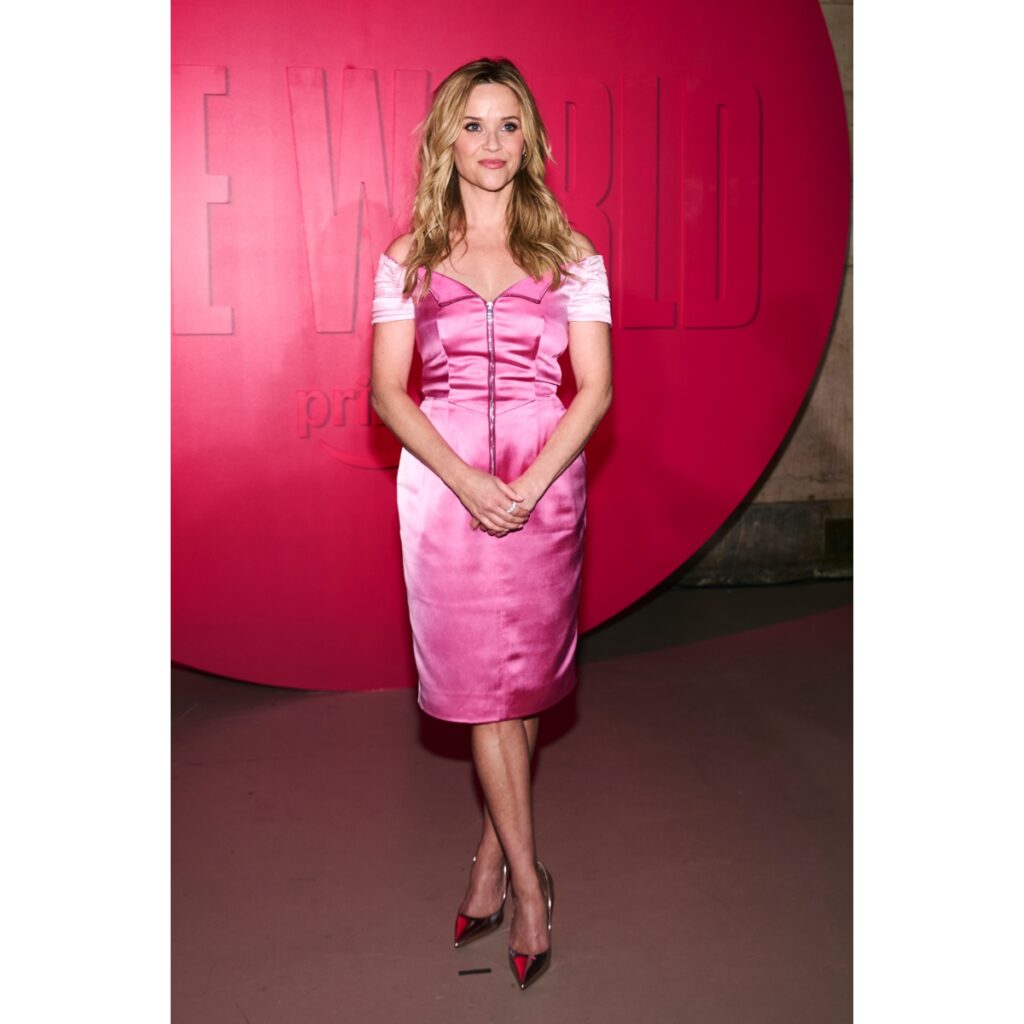
Reese Witherspoon in Prada
When Legally Blonde first appeared in 2001, Elle Woods walked into Harvard Law School like a cultural misunderstanding in heels. She was blonde, cheerful, wealthy, interested in beauty, fluent in fashion, and dressed in pink. In other words, she carried every visual code that modern culture had been trained to dismiss.
Then came the twist. She was not stupid. She was not ornamental. She was not rescued by a serious man in a serious suit. She succeeded because she was attentive, loyal, disciplined and underestimated.
That was the quiet genius of Elle Woods. She did not reject femininity to become powerful. She used femininity as part of her intelligence. Her pink wardrobe was not a costume of weakness; it was a refusal to translate herself into a more acceptable language.
This still feels radical. Even now, a woman who dresses in a traditionally feminine way often has to perform extra competence. She must prove that the lipstick is not a distraction, the dress is not vanity, and softness is not a lack of authority.
Pink Was Not Always “For Girls”
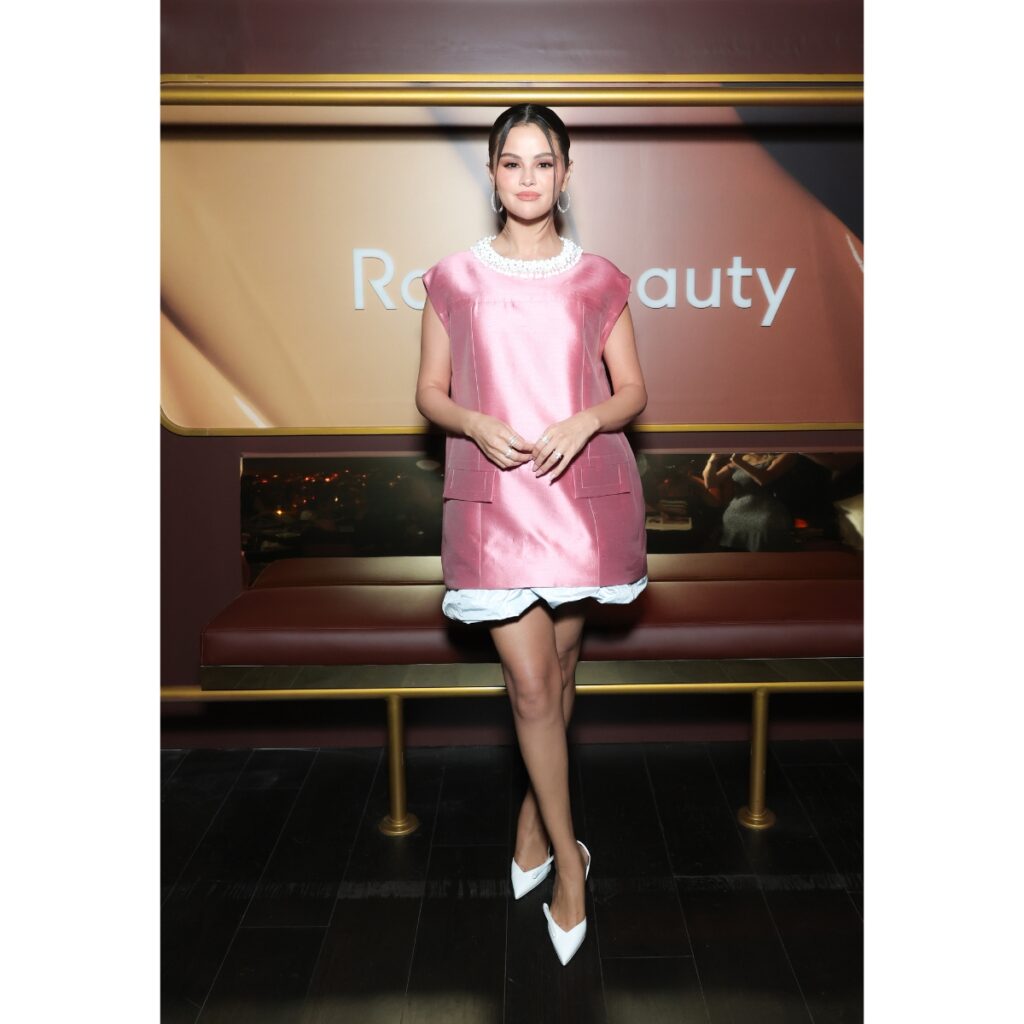
Selena Gomez in Prada
The idea that pink is naturally feminine is more modern than most people imagine.
In 18th-century Europe, pink was worn by men and women, especially in aristocratic circles. It belonged to silk, powder, theatre, pleasure and display. Pink was not weak. It was expensive, visible and social.
The stricter gender coding of pink and blue developed much later, particularly in the 20th century, through children’s clothing, marketing and domestic culture. Once pink became attached to girlhood, it also inherited the cultural prejudice attached to girls: charming, pretty, unserious.
A colour did not lose power by nature. It lost power by association.
The Real Fear Is Feminine Confidence
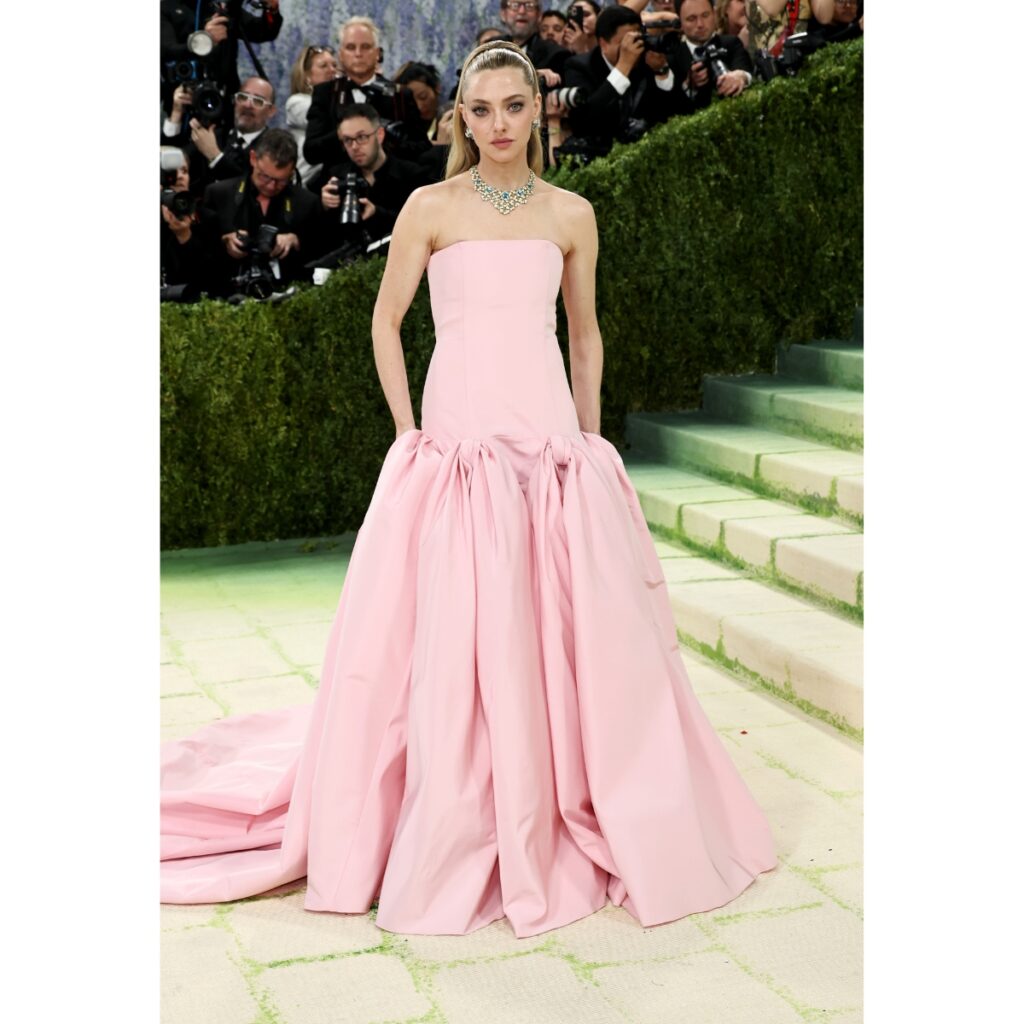
Amanda Seyfried in Prada
What unsettles people about pink is not the colour itself. It is what pink represents when worn without apology.
Masculine codes are easier to read. A black blazer says authority. Navy says discipline. A white shirt says competence. Minimalism says control. These are useful languages, and many women wear them brilliantly.
But pink speaks in a more complicated grammar. It brings feeling into the room. It allows beauty, pleasure, seduction and softness to stand beside ambition. It does not pretend that authority must be dry.
And this is where culture becomes nervous. A woman who is feminine and submissive can be contained. A woman who is powerful and masculine can be understood. But a woman who is both feminine and self-possessed is harder to categorise.
She is not asking to be protected. She is not asking to be approved. She is not apologising for being visible.
The French Lesson

Gwyneth Paltrow in Prada
Of course, we must be careful with national myths. Not every French woman is walking through Paris in a silk blouse, red lipstick and emotional ambiguity. Many are wearing trainers, carrying groceries, and looking as tired as the rest of Europe on a Monday morning.
Still, the French feminine ideal offers an interesting contrast. In France, at least in its most exported form, emancipation has not always required the rejection of sensuality. A woman can be intellectual and seductive, political and perfumed, serious and interested in how a jacket falls on the shoulder.
This does not mean France has solved womanhood. Far from it. But French culture has often allowed a more fluid relationship between femininity and authority. A woman does not necessarily need to dress like a man to be considered adult.
In Germany, Austria and much of Northern Europe, the visual language of female competence tends to be more pragmatic. Practicality carries moral weight. Too much visible effort can feel suspicious, unserious or vain. In the United States, the tension appears differently: women are encouraged to be attractive, but in professional spaces they often borrow masculine codes to signal power. The blazer becomes armour. The neutral palette becomes evidence of discipline.
There is nothing wrong with borrowing masculine codes. Women have always borrowed, adapted and transformed what was once denied to them. The problem begins when those codes become the only acceptable route to respect.
Read also: Michelle Obama’s The Look Book: Style, Power, and the Contradictions We Can’t Ignore
Pink As Armour, Not Apology
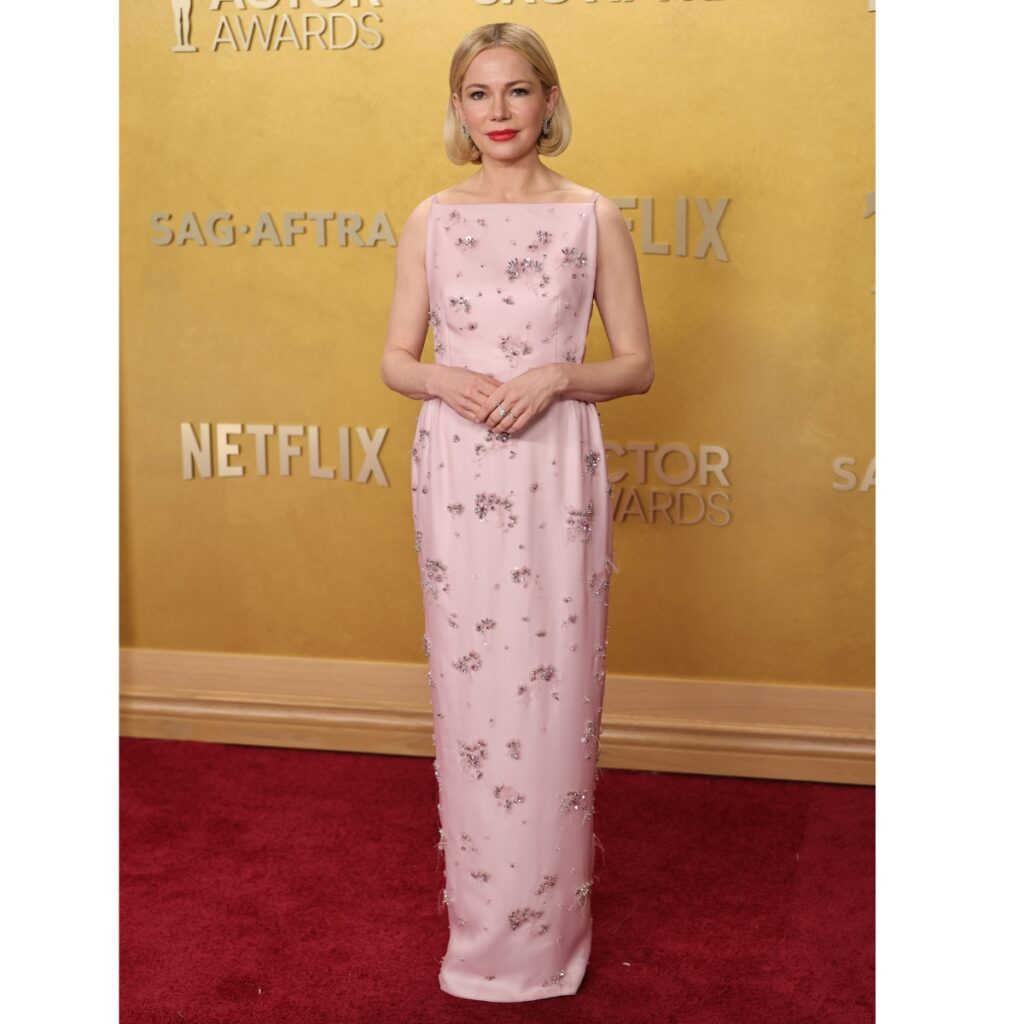
Michelle Williams in Prada
This is why pink still matters. It exposes the hidden rulebook.
Do we admire strength only when it resembles masculinity? Do we trust women more when they look less interested in beauty? Do we confuse restraint with seriousness and softness with surrender?
A powerful woman is not powerful because she rejects femininity. She is powerful because she chooses her own relationship with it.
For some women, freedom looks like a black suit and flat shoes. For others, it looks like a pink satin dress, diamond earrings, perfume and a perfectly timed smile. The point is not the colour. The point is agency.
Pink can be armour precisely because people underestimate it. It lets others reveal their prejudice first.
Femininity Is Not The Opposite Of Power
We have spent decades telling women they can be anything. Yet we still become uncomfortable when they choose to be feminine without seeming naïve, decorative without being available, pretty without being passive, sensual without being unserious.
Pink sits at the centre of this discomfort. It is the colour of the nursery and the protest sign, the powder room and the runway, the princess dress and the political statement. It carries too many meanings to be obedient.
Perhaps that is why it survives.
Pink was never weak. It was made to seem weak because femininity was made to seem weak. And every time a woman wears it with intelligence, humour and self-possession, she quietly rearranges the argument.
Not all power needs broad shoulders.
Some power arrives in satin.
All images courtesy @Prada
SHARE



