Louis Vuitton Idylle Blossom: The Flower That Began on a Trunk

Created by Georges Vuitton in 1896 to protect the family name, the Monogram Flower has travelled from coated canvas to white gold and diamonds. The new Idylle Blossom collection reveals why the motif has endured for 130 years.
There is something rather intriguing about a luxury symbol that began as defence.
In 1896, Georges Vuitton created the Louis Vuitton Monogram partly to distinguish the family’s increasingly copied trunks from their imitators. The interlaced initials were accompanied by stylised floral forms: geometric enough to be recognised from a distance, yet ornamental enough to belong to the visual language of late-19th-century Paris.
The pattern was also personal. Georges designed it in tribute to his father, Louis Vuitton, who had died four years earlier. What became one of the most recognisable signatures in fashion was therefore both a practical mark of authenticity and a form of filial memory.
Now, 130 years later, the Monogram Flower appears again in Louis Vuitton’s new Idylle Blossom jewellery, interpreted in white gold and diamonds. But to understand why the pieces matter, we must first return to the strange and rather beautiful history of the flower itself.
The Origins of the Louis Vuitton Monogram Flower
The original Monogram was composed of four principal elements: the LV initials, a rounded four-petal flower, a pointed star-like flower and a diamond-shaped frame containing another floral motif.
They were not flowers in the naturalistic sense. No botanist could identify them. They occupied a more intriguing territory between blossom, star, coat of arms and architectural ornament.
Louis Vuitton describes Georges’s design as a meeting of Art Nouveau, Japonism and Gothic heraldic art. The House has also connected the pattern to the decorative tiles found in the Vuitton family home in Asnières.
This mixture helps explain the Monogram’s longevity. It is neither entirely romantic nor rigorously geometric. It can appear feminine without becoming sweet, historic without looking archaeological. Like the best symbols, it is specific enough to be recognised and abstract enough to be endlessly reinterpreted.
Its first task was to establish ownership. Before logos became social signals, the Monogram served almost as a maker’s seal: this trunk was Louis Vuitton, and not one of the many copies attempting to pass for it.
In that sense, the flower was never innocent. It carried questions of authorship, authenticity and value from the beginning.
From Canvas Pattern to Jewellery Motif
For much of its history, the Monogram Flower lived on the surface of an object. It repeated across trunks, travel bags and small leather goods, creating rhythm rather than demanding individual attention.
Jewellery changed that relationship.
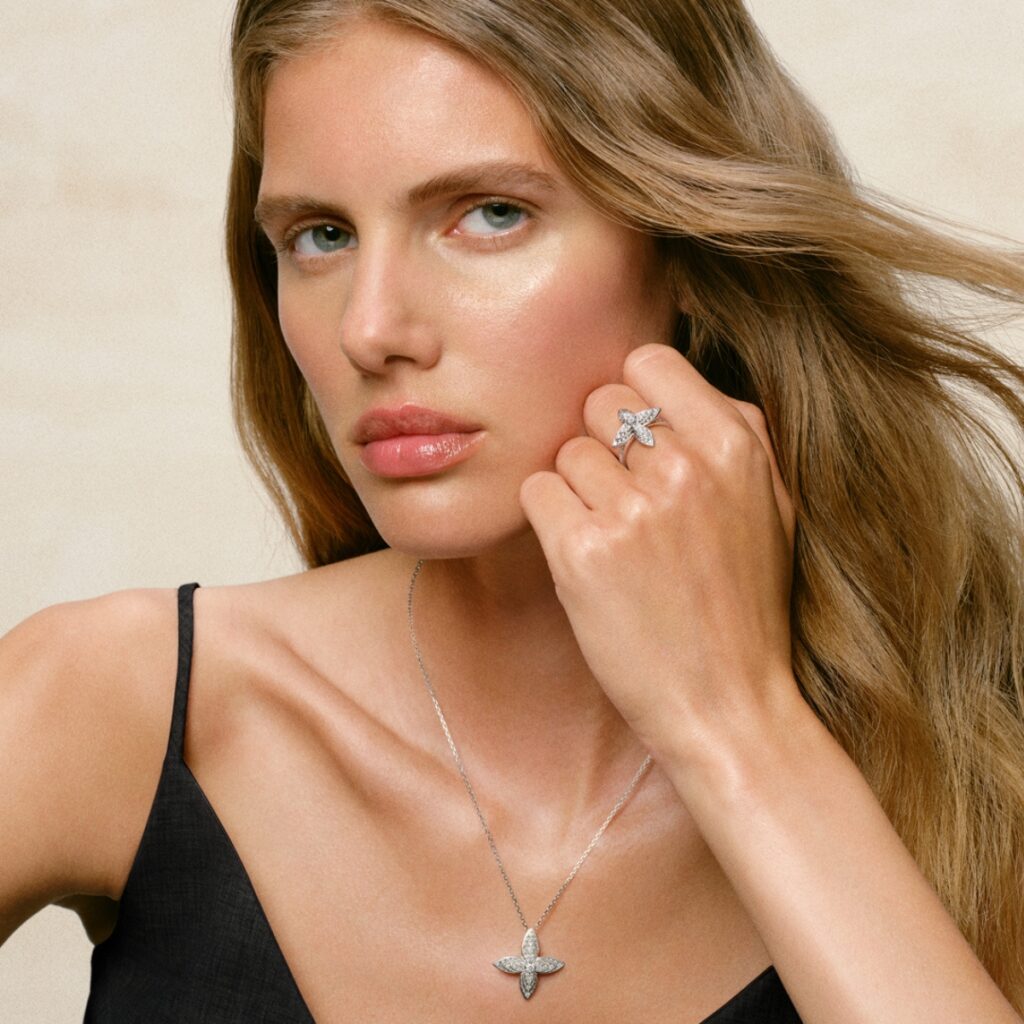
When Louis Vuitton introduced the Idylle Blossom collection in 2012, the House removed the flower from the familiar brown canvas and allowed it to stand alone. A small element within a repeating pattern became a pendant, an earring or a ring — something with volume, weight and its own place against the body.
The transformation is more significant than it first appears.
On canvas, the Monogram tells us who made the bag. In jewellery, the flower becomes less an external declaration and more a personal emblem. It no longer covers an object; it rests on the skin.
That shift from pattern to talisman is at the heart of Idylle Blossom.
Why the Motif Works So Well in Gold and Diamonds
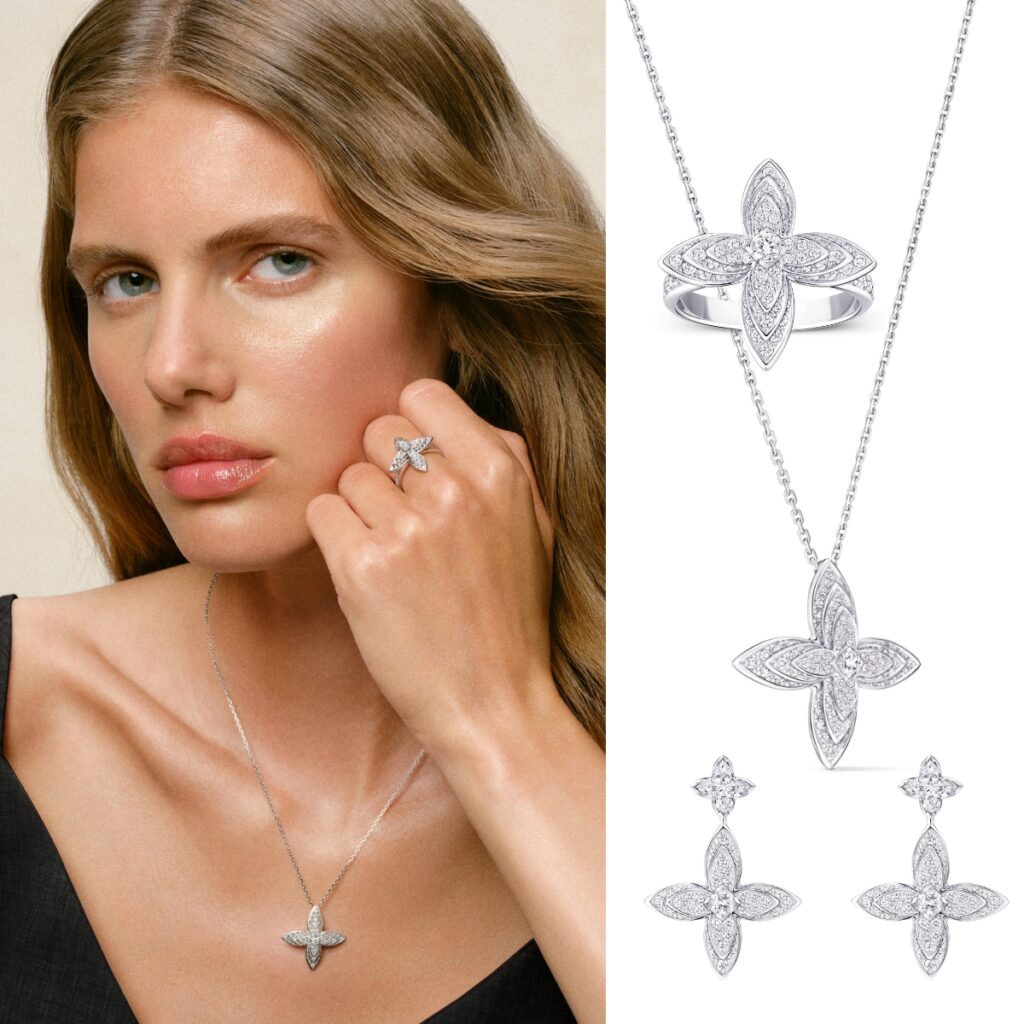
The new 2026 creations concentrate on the tapered, star-like version of the Monogram Flower. Its petals are chased and sculpted in white gold, then layered to create a three-dimensional structure. Pavé diamonds emphasise the sharp contours, while a round diamond occupies the centre of the flower.
The fine-jewellery set includes a ring with a pavé band, a pair of earrings and a pendant. They are deliberately wearable pieces, although the geometry prevents them from becoming merely pretty.
Flowers in jewellery can easily drift towards sentimentality. The Monogram Flower avoids this because it has never tried very hard to resemble a real blossom. Its symmetry is closer to a compass, a star or a heraldic device. The diamonds do not soften the design so much as clarify it.
This is jewellery with a floral name and an architectural temperament.
The LV Monogram Star Cut: When the Flower Becomes the Diamond
The historical idea becomes even more literal in the accompanying high-jewellery set.
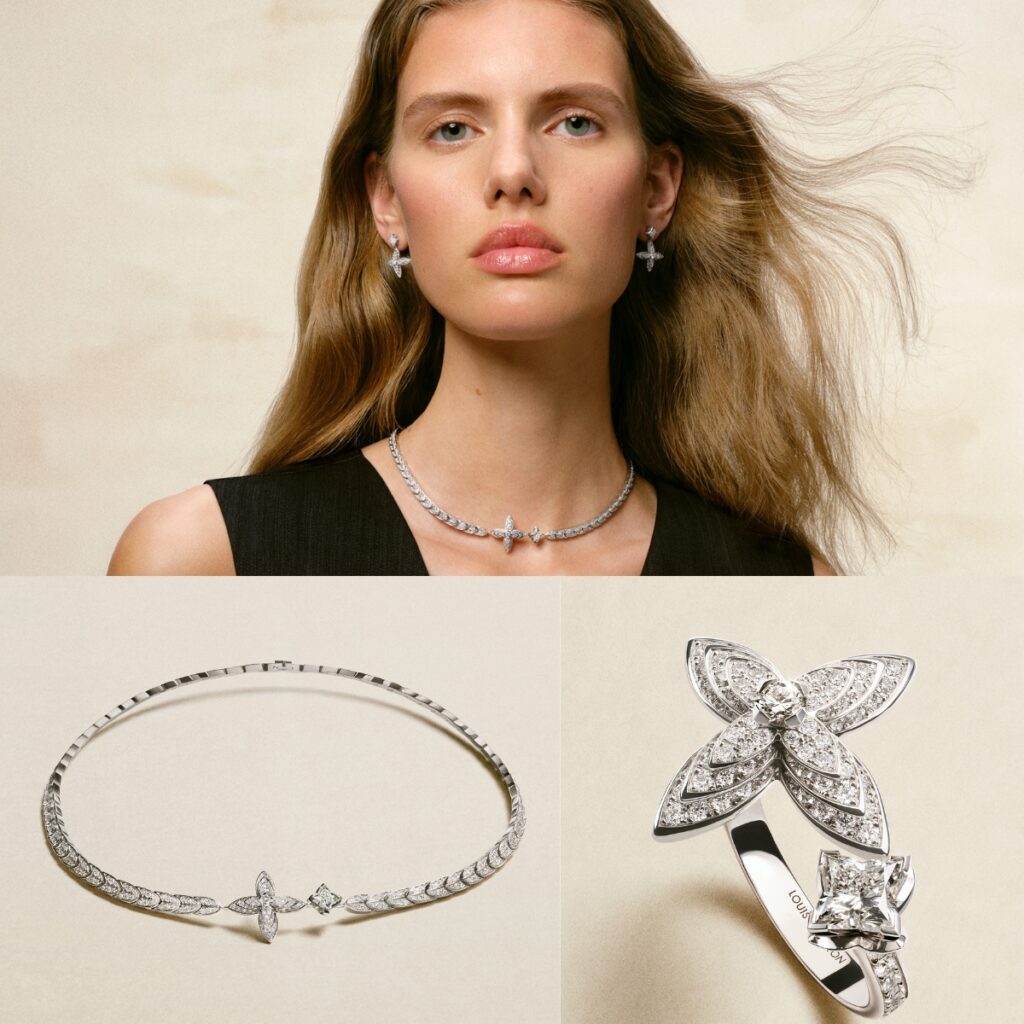
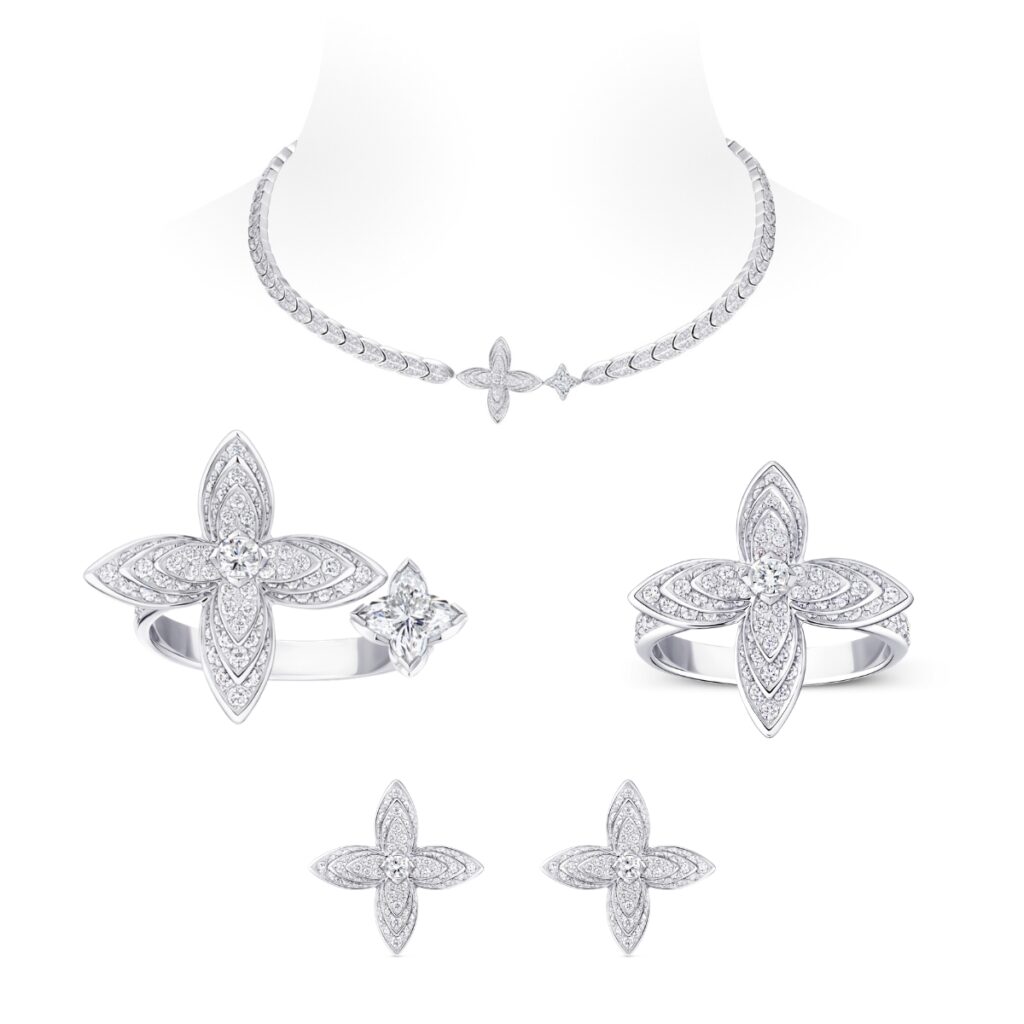
Here, the pavé Monogram Flower is paired with Louis Vuitton’s proprietary LV Monogram Star cut diamond. Rather than placing a conventional diamond beside the House symbol, Louis Vuitton has shaped the diamond itself into the pointed flower.
The cut has 53 facets and five pointed tips, turning the motif from a gold setting into the actual geometry of the gemstone.
It is a clever reversal. In 1896, Georges Vuitton designed a flower to certify the object. Today, the most precious object in the jewel — the diamond — carries the shape of that same certificate.
The high-jewellery parure consists of a short necklace, earrings and an open Toi et Moi ring. In the ring, the sculpted pavé flower faces the LV Monogram Star diamond, as though the original drawing were meeting its most precious descendant. The necklace curves closely around the neck, with the two versions of the motif positioned at its centre.
The pieces are lavish, naturally, but the more interesting story lies in this conversation between image and material: a flower once printed onto luggage is now carved into a diamond.
A Logo, or a Family Coat of Arms?
The word logo feels slightly inadequate here.
Logos belong to commerce, speed and instant recognition. The Monogram certainly performs those functions, but its origins are closer to a family cypher or coat of arms. Georges Vuitton was not simply designing a marketable pattern. He was protecting his father’s work and giving the family business a visual identity that could survive beyond one generation.
This explains why the flower continues to work even after decades of extreme visibility. Its meaning does not depend on novelty.
Fashion usually fears repetition. A motif repeated too often can become exhausted, familiar to the point of invisibility. Yet heritage houses rely upon a different rhythm. Their task is not to replace a symbol every season, but to reconsider it without severing it from its past.
Idylle Blossom succeeds when it allows us to see the Monogram Flower again — not as background, but as design.
The Real Luxury Is Continuity
At a moment when brands produce new codes at considerable speed, Louis Vuitton is returning to a drawing made in the 19th century.
This is not nostalgia. The new jewels do not reproduce an antique piece or pretend that modern women still inhabit Georges Vuitton’s world. Instead, they demonstrate something luxury occasionally forgets: reinvention carries more weight when there is something substantial to inherit.
The Monogram Flower has moved from the tiled interiors of Asnières and the canvas of travelling trunks to rings, necklaces and diamonds. Along the way, it has remained a sign of identity, craftsmanship and continuity.
Perhaps that is why it feels particularly convincing in jewellery. Gold and diamonds are expected to last. So are the symbols we choose to pass on.
Images courtesy of ©LouisVuitton
SHARE



