Lauren Sánchez Bezos: Villain, Victim, or Mirror?

There is something uncomfortable about admitting that judging another woman is wrong — and then realising we have already done it before breakfast.
Lauren Sánchez Bezos inspires a particular kind of public reaction. Not simply dislike, but permission. Permission to comment on her face, her body, her clothes, her marriage, her money, her ambition, and the exact amount of space she is allowed to occupy in rooms built by power.
After the 2026 Met Gala, the internet seemed to agree on one thing: Lauren Sánchez Bezos was too much. Too visible. Too rich. Too surgically polished. Too close to power. Too willing to enjoy it.
And yet, perhaps the real question is not whether Lauren Sánchez Bezos is tasteful enough, elegant enough, or morally acceptable enough for the public imagination.
Perhaps the real question is why we need her to be the villain.
Who Is Lauren Sánchez Bezos, Really?
Before she became the woman beside Jeff Bezos, Lauren Sánchez Bezos had a life of her own. She was born in Albuquerque, New Mexico, into a Mexican-American family. Her father was a flight instructor and mechanic, and aviation became one of the more genuinely fascinating parts of her story. Sánchez is a licensed pilot and founded Black Ops Aviation, an aerial film and production company.
This detail matters because it complicates the caricature. A woman who flies helicopters is harder to reduce to jewellery, waistlines and red carpets.
She also speaks openly about dyslexia. Sánchez has said she was diagnosed at El Camino College after a professor recognised her difficulties, and she has since connected that experience to her children’s book The Fly Who Flew to Space. The book follows a curious fly who struggles at school but ends up on an unexpected journey into space.
There is something almost too symbolic here: the woman mocked as artificial writes a story about a misunderstood creature who flies higher than expected.
Life has a sense of humour. Sometimes it is a little rude.

Lauren Sanchez Bezos
From Lauren Sánchez to Lauren Bezos
Lauren Sánchez had a long media career before becoming Mrs Bezos. She worked as a television journalist, entertainment reporter and anchor, with roles connected to Fox Sports Net, Good Day L.A., Extra, and So You Think You Can Dance.
Her private life, of course, became much more public than her professional one. She has three children: one with former NFL player Tony Gonzalez, and two from her marriage to Hollywood agent Patrick Whitesell. Her relationship with Jeff Bezos became public while both were still married to other people, and both divorces followed in 2019.
This is the part where many people close the file and declare the sentence: homewrecker, social climber, billionaire wife, end of story.
But human beings are rarely that tidy.
From a moral point of view, adultery is not romantic simply because it later becomes respectable. It leaves pain behind, even when the public never sees the wound. Still, if every person who had made a grave personal mistake were condemned to permanent villain status, society would need to cancel almost everyone by Thursday.
We can name the wrong without pretending we know the entire soul.
Why Is Lauren Sánchez Bezos So Easy to Hate?
At the 2026 Met Gala, Lauren Sánchez Bezos and Jeff Bezos served as honorary chairs and lead sponsors of the event, while the gala’s official co-chairs included Beyoncé, Nicole Kidman, Venus Williams and Anna Wintour. The theme, “Fashion Is Art,” accompanied the Costume Institute exhibition Costume Art.
Her presence sparked backlash, not only because of her Schiaparelli dress, but because of what she represents: extreme wealth entering the cultural temple through the front door, wearing couture and diamonds.
Business Insider reported that the 2026 Met Gala became a focus for criticism of billionaires, with protests and online backlash aimed at Bezos and Sánchez Bezos in particular. The event also reportedly raised a record $42 million for the Costume Institute.
And here lies the tension. The Met Gala needs money. Culture increasingly depends on donors. But the public still wants to believe that taste, beauty and cultural legitimacy cannot simply be bought.
Lauren Sánchez Bezos became the face of that contradiction.
Not because she invented it, but because she wore it.
The Sin Nobody Wants to Name
Envy is often misunderstood. It is not only wanting what another person has. In its darker form, envy is sorrow at another person’s good. It is the small interior voice that says: if I cannot have this, she should not have it either.
Lauren Sánchez Bezos has access to a scale of life most people can only imagine. Space travel. Venice weekends. couture fittings. diamond rings large enough to become architecture. A seat at the Met Gala not as a guest, but as a patron.
This produces a moral irritation we rarely confess.
Because if she can turn ambition into spectacle, why can’t we? If she can redesign her life at 56, why can’t we? If she can enter the room after being mocked, criticised and reduced to a punchline, why is she still standing there, smiling?
That may be the part people find hardest to forgive.
What Do We Actually Want?
There is another question hidden beneath the gossip: what would we do with unlimited access?
Would we travel to space? Close Venice for a weekend? Buy museum influence? Wear a diamond large enough to require its own security detail?
Or would we become more serious?
Would we love our families better? Visit the lonely? Support schools, hospitals, prisons, shelters? Use visibility to protect women rather than perform power? Teach younger generations that beauty without dignity becomes costume, and ambition without responsibility becomes noise?
It is easy to criticise someone else’s dreams when we have not examined our own.
Perhaps the real scandal is not that Lauren Sánchez Bezos wants too much. Perhaps the scandal is that many of us want too little — or want the wrong things with excellent taste.
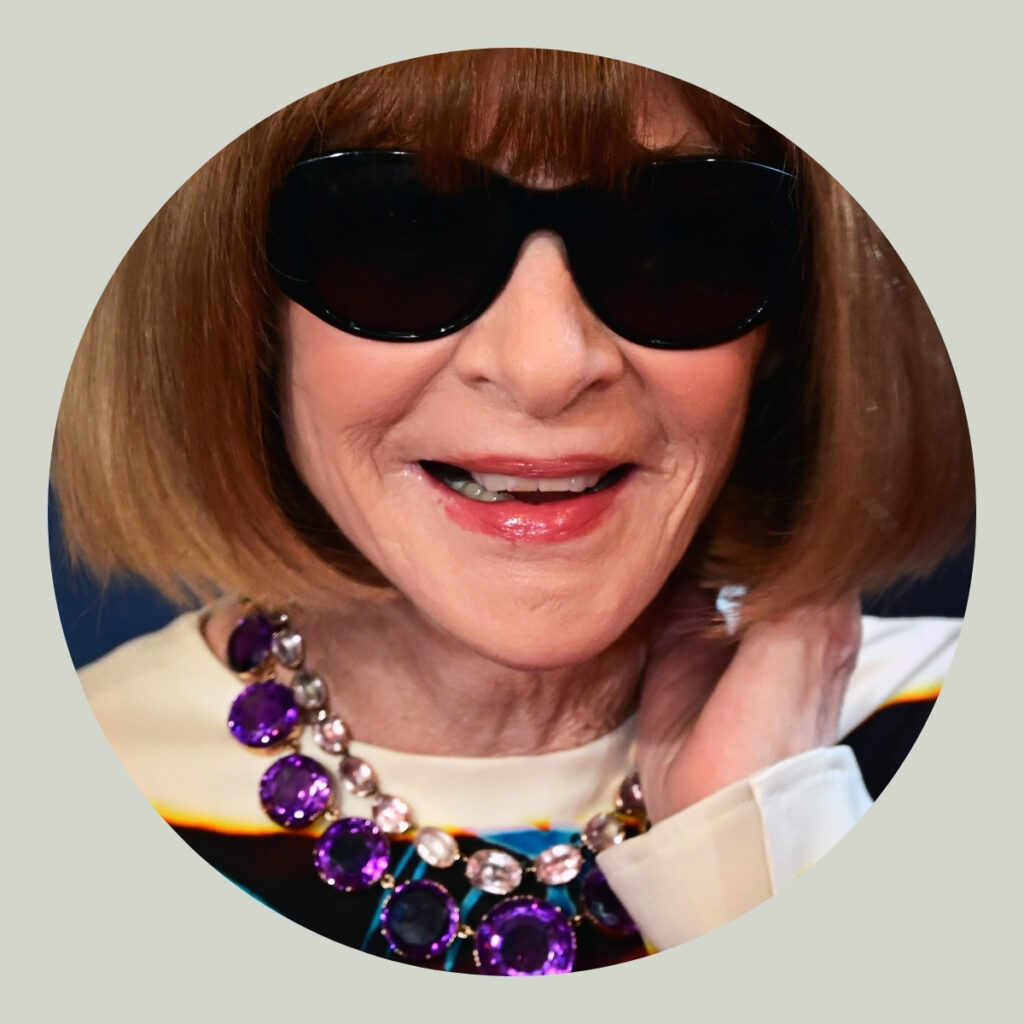
Anna Wintour
Is Anna Wintour the Real Villain?
That is another article, and it requires a deep breath.
Still, fashion should not pretend innocence. Anna Wintour has held enormous cultural power for decades. Vogue and Condé Nast helped shape the visual ideals of modern womanhood: thinness, youth, sexual polish, luxury as social proof, and the idea that a woman’s body is always available for public evaluation.
In 2018, after allegations of sexual misconduct against major fashion photographers Mario Testino and Bruce Weber, Condé Nast said it would not work with them for the foreseeable future and introduced a new code of conduct for shoots.
That response mattered. But it also revealed how long fashion had tolerated environments where beauty, power and vulnerability were dangerously entangled.
So before we place all moral blame on one woman arriving in Schiaparelli, perhaps we should look at the system that trained us to evaluate women as objects and then punish them for looking manufactured.
Lauren Sánchez Bezos did not create that system.
She simply walked into it wearing diamonds.
Let Lauren Be — But Ask Better Questions
This is not a defence of vulgar wealth. Nor is it an invitation to confuse visibility with virtue.
Lauren Sánchez Bezos may not be the symbol of restraint, quiet elegance or old-world grace. She may never become the patron saint of understated European chic. That is fine. The calendar is full.
But turning her into a plastic villain only reveals our own lack of charity.
The more interesting task is to ask what her public treatment says about us. About envy. About women ageing under surveillance. About money entering culture. About beauty becoming performance. About the strange pleasure society takes in humiliating women who do not know how to disappear.
So let it be, Lauren.
May your ambitions grow larger than spectacle. May your dreams reach beyond space travel and gala carpets. May they become useful, dignified, and perhaps even quietly good.
And may the rest of us become ambitious enough to stop confusing judgment with discernment.
Feature Image WikimediaCommons
SHARE



