Schiaparelli at the V&A: The Surrealist Queen Takes London

Elsa Schiaparelli did not design for wallflowers. She designed for women who enjoyed the theatre of getting dressed, the sort of woman who understands that a shoulder can be an argument and a button can be a joke. So yes, Schiaparelli at V&A is a very suitable stage for the surrealist designer. She knows a thing or two about spectacle.
Opening at V&A South Kensington on 28 March 2026, Schiaparelli: Fashion Becomes Art runs until 8 November 2026 and marks the UK’s first exhibition dedicated to Elsa Schiaparelli. The museum says the show spans the 1920s to today, tracing the founder’s influence and the evolution of the house under current creative director Daniel Roseberry.
That date range tells you everything. This is not a dusted-off parade of pretty gowns arranged for polite admiration. It is a full, glittering argument for Schiaparelli as one of fashion’s great original minds, a designer who understood that clothing could seduce, amuse, provoke and bewilder all at once.
Fashion with a raised eyebrow
Elsa Schiaparelli remains fascinating because she treated fashion as a form of cultural mischief. Other designers offered elegance. She offered elegance with a pulse. A sense of humour. A little venom in the lipstick.
The V&A describes her work as innovative and influential, and the house itself still defines her legacy through imagination, Surrealism and revolutionary thinking across couture, sportswear, fragrance and objects.
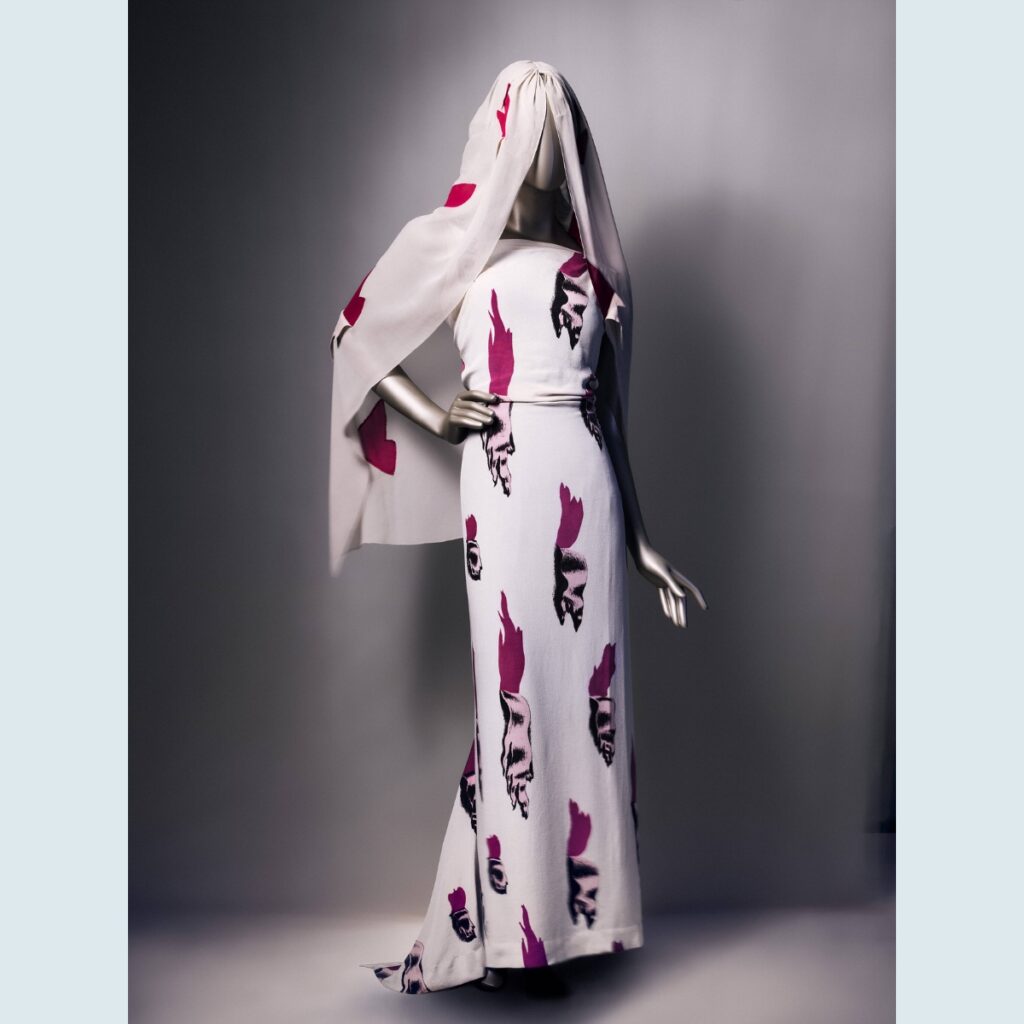
Tears dress with veil, designed by Elsa Schiaparelli and Salvador Dalí, summer 1938 – Photograph ©Emil Larsson
That is why Schiaparelli still feels so alive. She never made the mistake of thinking beauty had to behave. Her clothes flirted with illusion, visual puns, anatomy, dreams and absurdity. She designed as if the body were a salon for ideas.
In today’s climate, where so much luxury arrives with the soul of a corporate mood board, Schiaparelli feels like the glamorous troublemaker at the table. She is the woman who says the most interesting thing over dinner and wears the strangest brooch while saying it.
What the Schiaparelli at the V&A exhibition includes
The V&A’s exhibition makes clear that Schiaparelli’s world was never limited to dresses alone. The show highlights garments and accessories alongside artworks and images tied to her orbit, including the Skeleton Dress made with Salvador Dalí, the Tears dress, a portrait of Elsa by Man Ray, and the famous 1937 evening coat created with Jean Cocteau and Lesage, where two profiles bloom into a vase of roses.
That last piece alone deserves a small audience and a velvet rope. It looks like fashion flirting with hallucination.
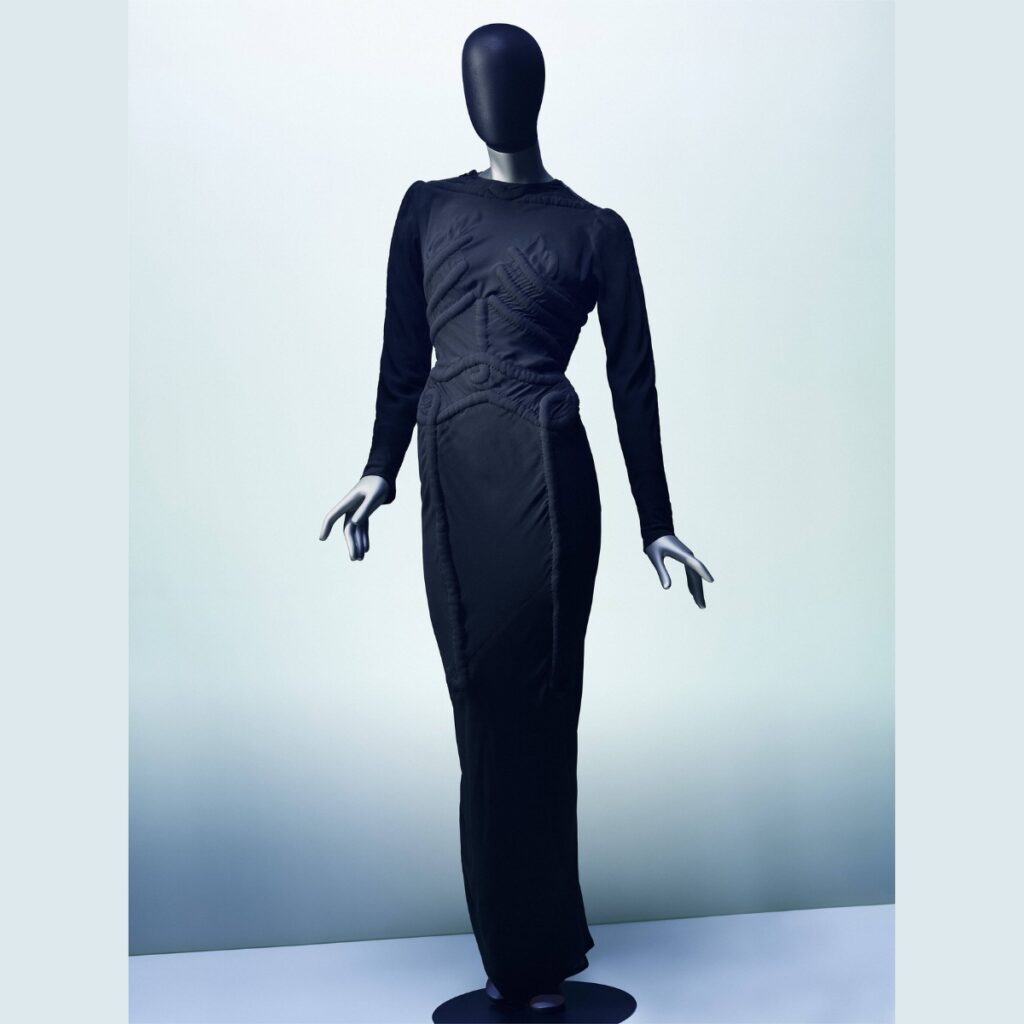
Skeleton Dress, designed by Elsa Schiaparelli and Salvador Dalí, 1938 – V&A ©2025 Salvador Dali, Fundació Gala-Salvador Dalí, DACS. Photograph ©Emil Larsson
And that is precisely the point of Schiaparelli at the V&A. Elsa Schiaparelli did not stand at the edge of the art world waving for attention. She moved inside it naturally. Her couture belonged to the same conversation as Surrealist painting, experimental photography and modern theatre. Fashion, in her hands, became a visual language with rhythm, irony and a taste for surprise.
Elsa Schiaparelli and the artists of her time
Some fashion collaborations feel like PR with a better tailor. Schiaparelli’s relationships with artists had real voltage.
Maison Schiaparelli continues to frame Elsa’s legacy through her connections with Dalí, Cocteau, Man Ray and Giacometti, describing those collaborations as legendary. The house also notes that Giacometti designed gilt-metal brooches and buttons in the shape of mythic and dreamlike figures during the 1930s.
With Salvador Dalí, Schiaparelli found a perfect accomplice. The house says their first collaboration was a powder compact shaped like a telephone dial, and their creative exchange soon produced some of fashion’s most unforgettable images, including the Lobster Dress and the Tears Dress.
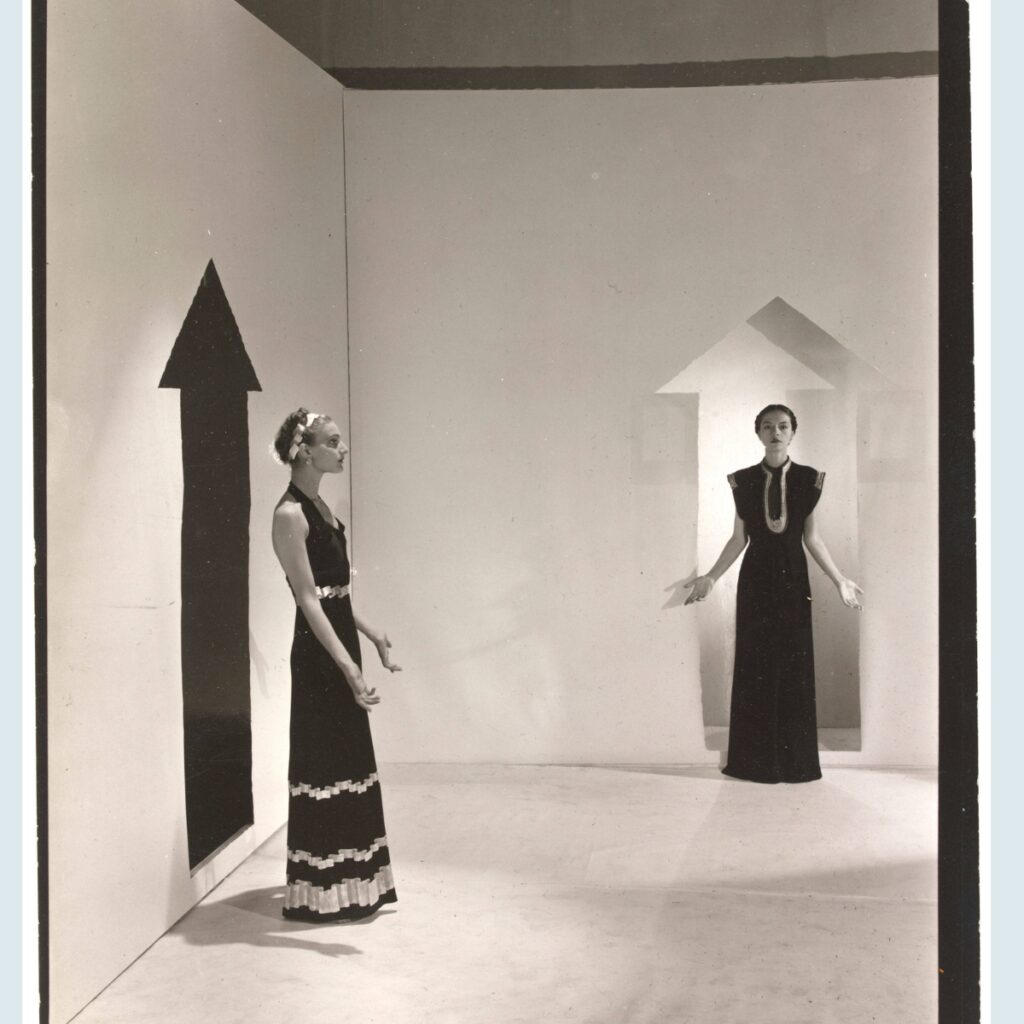
Schiaparelli evening dresses, photograph, by Cecil Beaton, commissioned by French Vogue, 1936, France – © Victoria and Albert Museum, London
With Jean Cocteau, the body became a line drawing in motion. With Man Ray, photography sharpened her mystique into something almost cinematic. With Giacometti, accessories turned into little surreal relics. These artists were not hanging around the edges of her work like fancy guests at a launch party. They were part of its electricity.
Schiaparelli understood something that still feels modern: clothes could borrow from art without becoming stiff or self-important. They could be clever and glamorous at the same time. They could wear their intelligence lightly, the way a great actress wears an insult in a screwball comedy.
A brief story of Schiaparelli in fashion
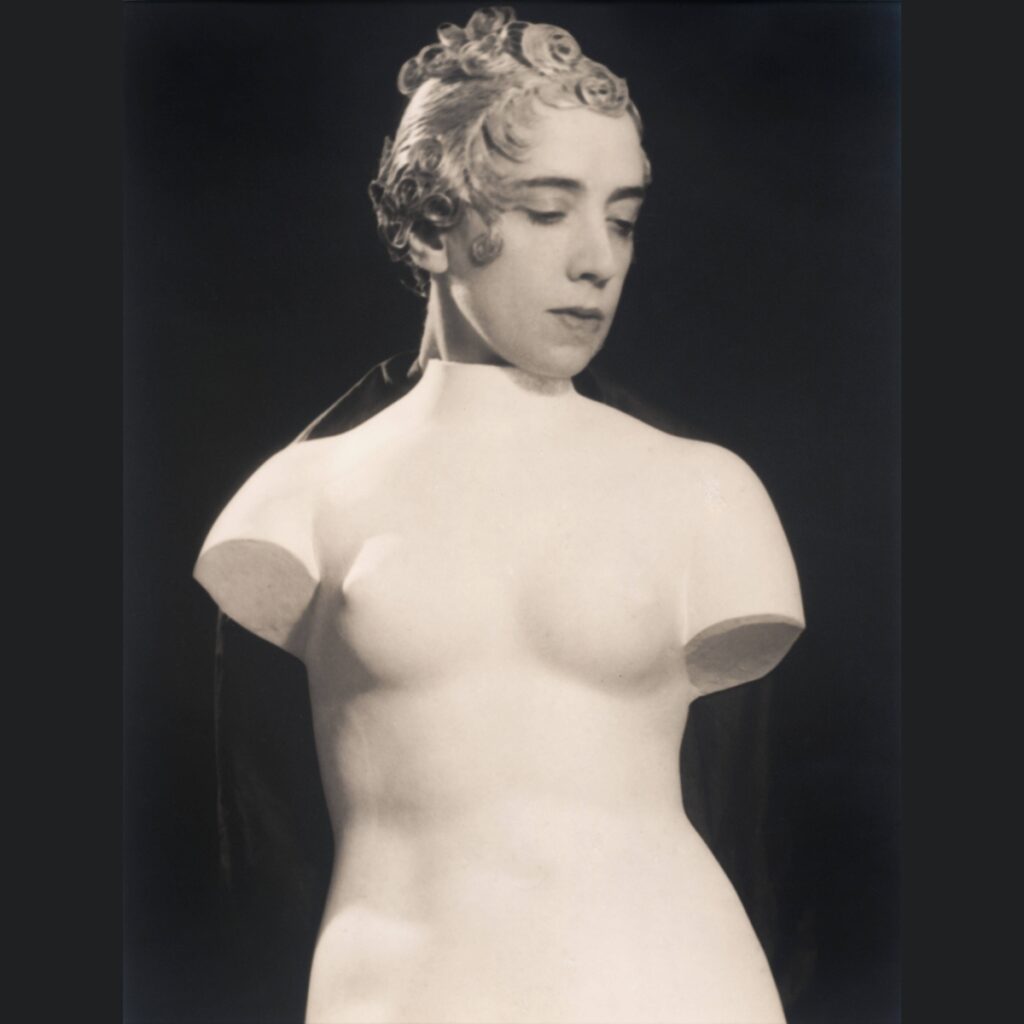
Portrait of Elsa Schiaparelli, by Man Ray, 1933 – © 2025 Man Ray 2015 Trust. DACS, London. Photo Collection SFMOMA. The Helen Crocker Russell and William H. and Ethel W. Crocker Family Funds purchase
Born in 1890, Elsa Schiaparelli built a career that still feels gloriously unruly. The V&A quotes her saying, “For me, dress designing is not a profession but an art,” which is either wonderfully grand or entirely true. Possibly both.
She emerged in Paris between the wars and developed a vocabulary unlike anyone else’s: trompe-l’oeil knitwear, theatrical fastenings, sculptural silhouettes, embroidered fantasy, and the now-iconic Shocking Pink that became inseparable from her name. Maison Schiaparelli notes that in 1937, the house launched the fragrance Shocking, along with the vivid pink tone that would become one of Elsa’s signatures.
She brought a new kind of excitement to couture because she refused to treat fashion as obedient decoration. Her clothes carried intellect, irreverence and spectacle in the same hand. Where some houses built their reputation on discipline and refinement, Schiaparelli built hers on imagination sharpened to a point.
That is why she still matters to the eye, even now. Her garments do not feel trapped in history. They feel like they are still talking.
The eternal Schiaparelli versus Chanel subplot
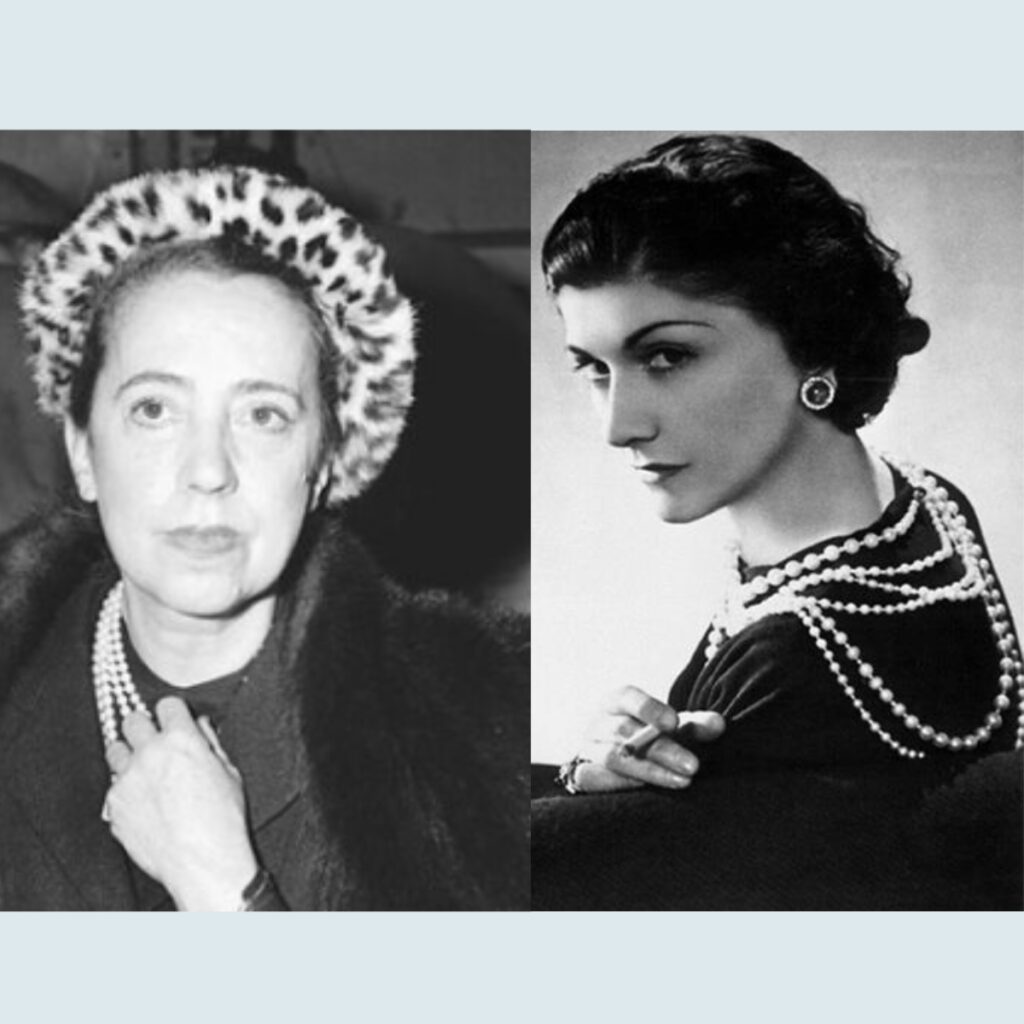
Elsa Schiaparelli and Coco Chanel – © commons.wikimedia.org
Fashion loves a duel, and history has long cast Schiaparelli and Chanel as opposite archetypes: one severe, one surreal; one controlled, one explosive. There is truth in that contrast, but it can be a little too tidy, like a biopic written by someone who loves a good rivalry more than a complicated woman.
Schiaparelli’s brilliance was never simple excess. She knew structure. She knew line. She knew exactly how far a joke could go before it stopped being chic and became a costume. That calibration is what kept her work powerful. A Schiaparelli garment might have a sense of play, but it was never careless. The wit was disciplined. The fantasy had architecture.
That is why museum treatment suits her so well. Once the noise of trend cycles drops away, you can see the precision more clearly.
Daniel Roseberry and the house today
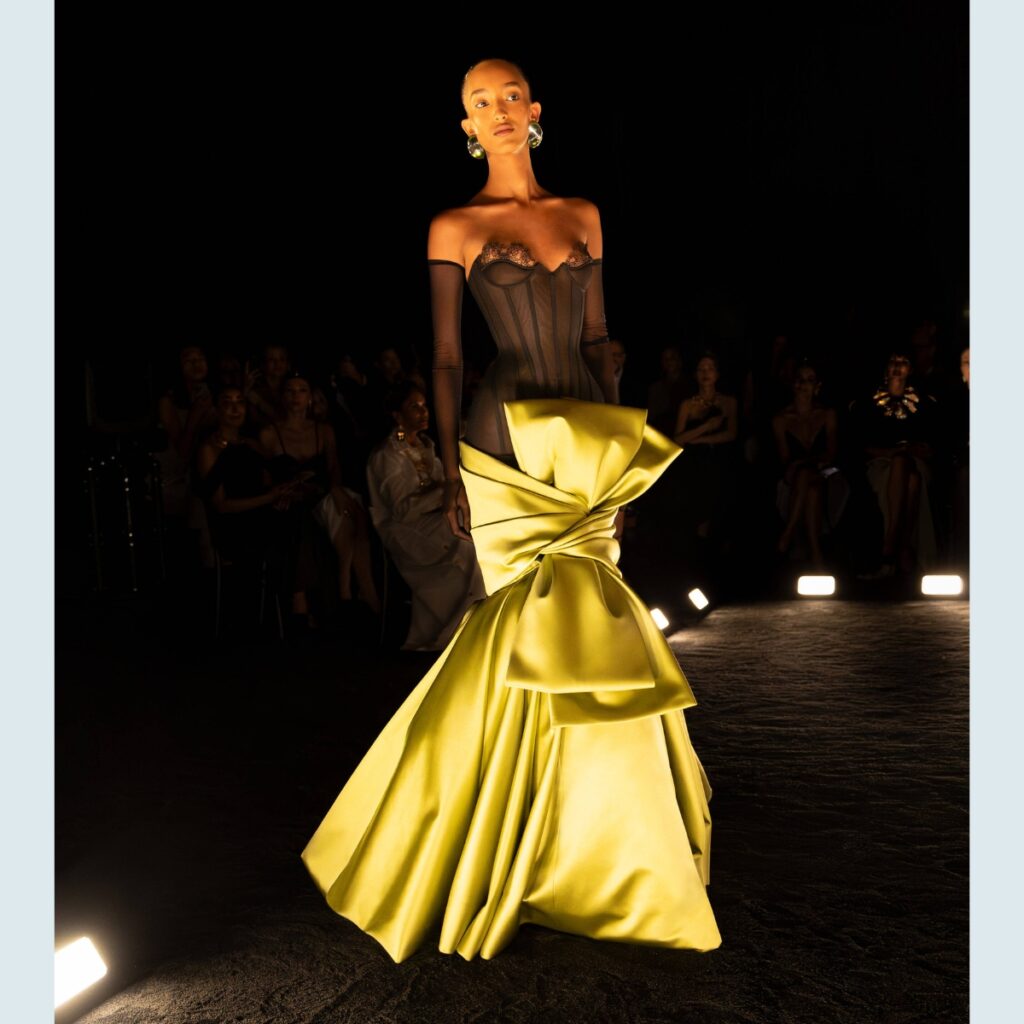
Schiaparelli Haute Couture autumn/winter 2024 – Photo © Giovanni Giannoni. Photo courtesy Patrimoine Schiaparelli, Paris
The exhibition also follows the house into the present under Daniel Roseberry, who, according to Maison Schiaparelli, joined in 2019 after ten years at Thom Browne, where he became head of design. The house credits him with reviving some of its most influential codes while honouring Elsa’s love of Surrealism.
Roseberry has been smart about Schiaparelli in the way few revivals are smart. He did not arrive to embalming-fluid the archive. He came to make the house feel dangerous again.
His version of Schiaparelli leans into gold anatomy jewellery, hard glamour, impossible waists, fetishistic polish and a kind of operatic confidence that thrives on the red carpet. The house itself describes him as distilling Schiaparelli’s codes in gold, and that feels apt.
At his best, Roseberry makes couture with the clarity of a movie close-up. The clothes read instantly, but they are never empty. They still carry that Schiaparelli quality of visual seduction mixed with a little delirium. They know that fashion is allowed to be excessive, especially when excess is done with intelligence.
And crucially, he has helped a wider audience understand Elsa again. Not as an eccentric relic. As a live wire.
Why Schiaparelli at the V&A feels timely
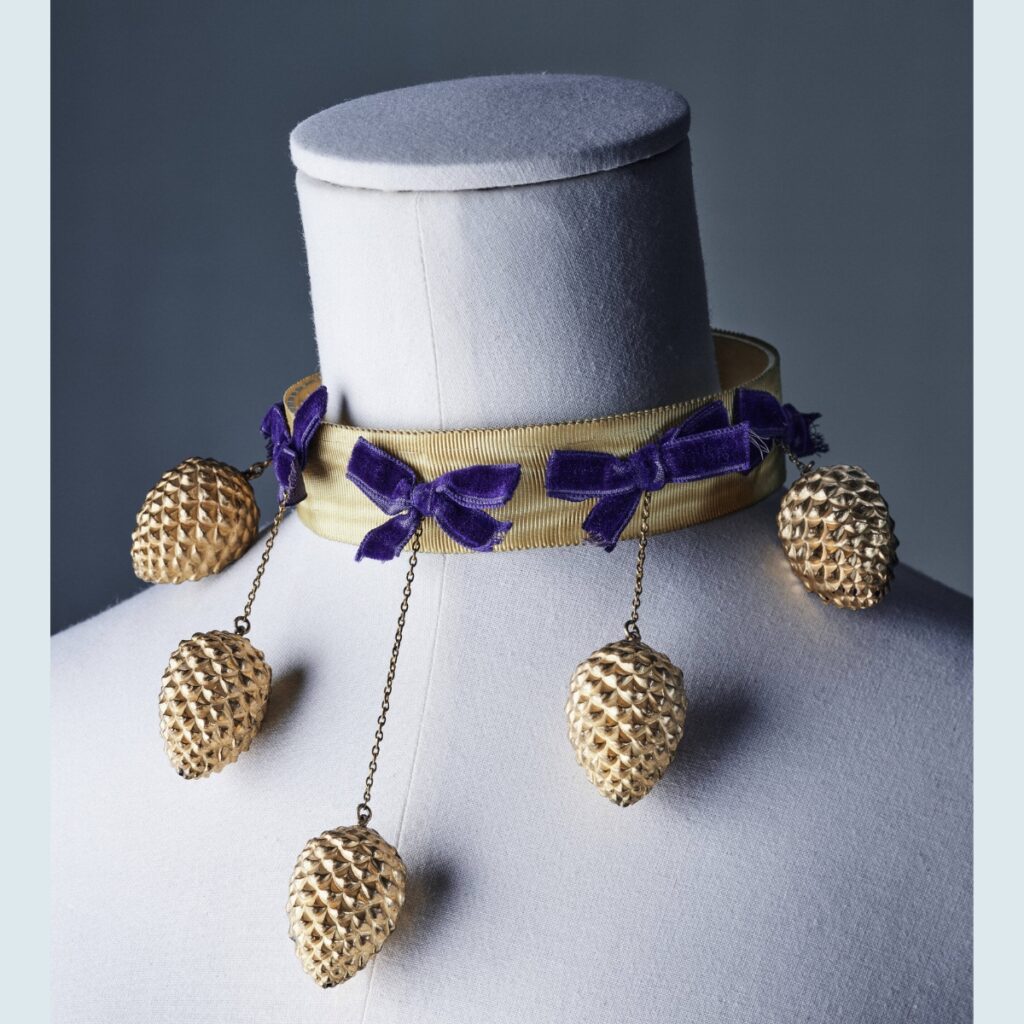
Choker by Schiaparelli, Pagan collection, autumn 1938 – Photograph © Emil Larsson
The pleasure of this exhibition lies in its refusal to shrink fashion into something useful, digestible or morally hygienic. Schiaparelli reminds us that clothes can still be imaginative, symbolic, and gloriously unnecessary, just as great art is. Nobody needs a lobster on a dress. That is exactly why it lingers in the mind.
The V&A’s show arrives at a good moment for that reminder. Fashion today often swings between sterile quiet luxury and cartoonish visibility, between understatement so cautious it barely exists and spectacle so empty it evaporates after one scroll. Schiaparelli offers another route. She gives us wit with skill. Fantasy with technique. Glamour with bite.
She also gives us a richer image of femininity. Her woman is chic, certainly, but she is also alert, witty, a little theatrical, and entirely unafraid of being seen. She does not dress to disappear into good taste. She dresses to make meaning visible.
That may be the deepest appeal of Schiaparelli at the V&A. It lets London encounter a designer who never confused elegance with obedience. Elsa Schiaparelli believed a gown could think, flirt and misbehave slightly. Thank heavens she was right.
Read Also: Art-Smart Outfit: What to Wear in a Museum or Gallery
FAQ
| What is Schiaparelli at the V&A about? | The exhibition, officially titled Schiaparelli: Fashion Becomes Art, explores Elsa Schiaparelli’s work from the 1920s to today, including her influence on fashion and the house’s present-day evolution under Daniel Roseberry. |
| When does the Schiaparelli exhibition open at the V&A? | The exhibition opens on 28 March 2026 at V&A South Kensington and runs until 8 November 2026. |
| Which artists collaborated with Elsa Schiaparelli? | Elsa Schiaparelli is closely associated with artists such as Salvador Dalí, Jean Cocteau, Man Ray, and Alberto Giacometti. |
| Why is Elsa Schiaparelli important in fashion history? | Elsa Schiaparelli is closely associated with artists such as Salvador Dalí, Jean Cocteau, Man Ray, and Alberto Giacometti. |
| Who is the current creative director of Schiaparelli? | The current creative director is Daniel Roseberry, who joined the house in 2019. |
Feature image – Choker by Schiaparelli, Pagan collection, autumn 1938 – Photograph © Emil Larsson
SHARE



