CeraVe Lawsuit Explained: What the Skincare Panic Really Means

The internet loves a beauty scandal. But does the CeraVe benzene lawsuit mean your cleanser is dangerous? CeraVe lawsuit explained.
There is a particular kind of modern panic that begins, innocently enough, with a bathroom shelf. One day, your cleanser is a sensible dermatologist-approved staple. Next, the internet is asking whether it has been quietly plotting against your bloodstream.
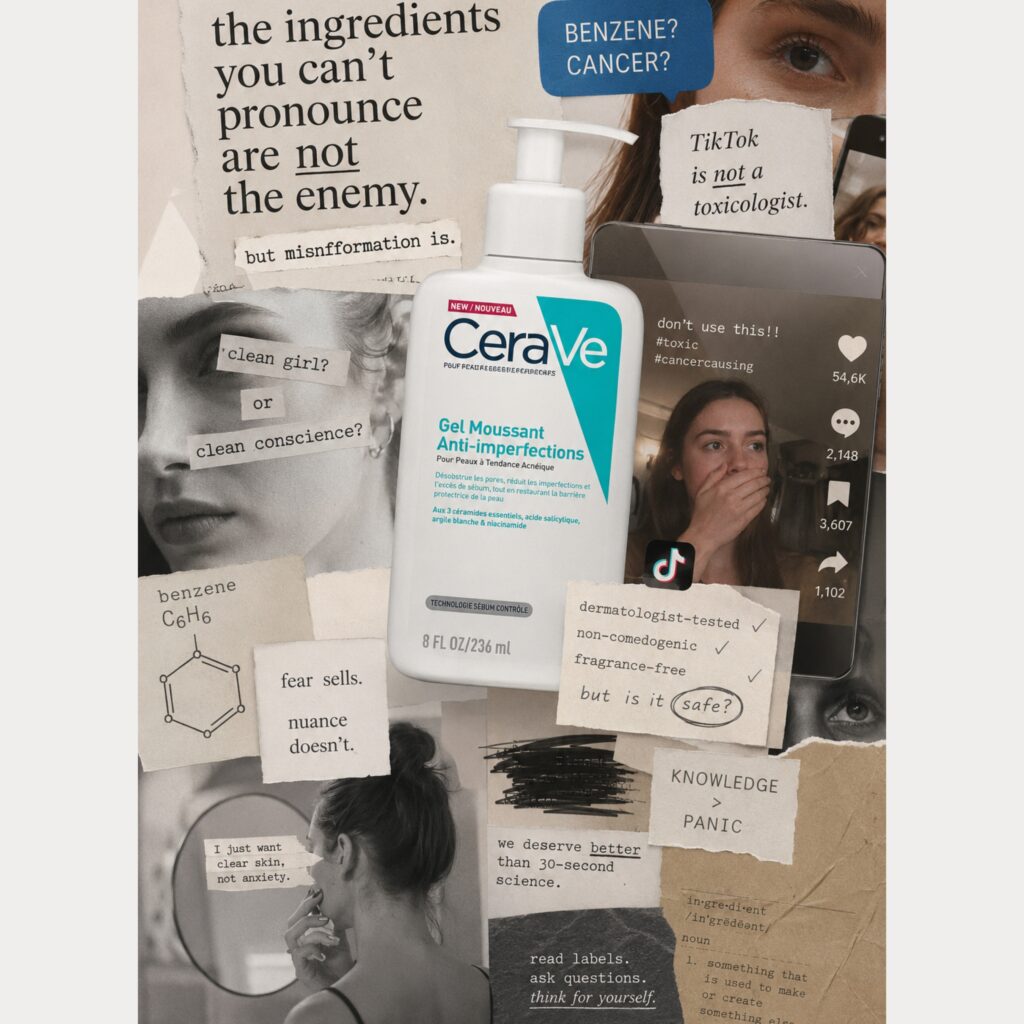
That is roughly what happened with CeraVe, the pharmacy skincare brand loved by teenagers, dermatologists, minimalists, and anyone who has ever whispered “barrier repair” after a bad retinol night. In June 2026, social media posts revived claims that CeraVe was being sued over a “cancer-causing chemical” in some acne products.
Technically, there is a real legal story here. But, as often happens when science meets TikTok, the useful context got left outside the bathroom door.
The CeraVe lawsuits are linked to two benzoyl peroxide acne products. The concern is not that benzene was intentionally added to the formulas. The allegation is that benzoyl peroxide, an acne-fighting ingredient, may degrade into benzene under certain conditions, especially heat.
That distinction matters. In beauty, as in life, the drama is often in the details.
What Are the CeraVe Lawsuits About?
L’Oréal USA, CeraVe’s parent company, has faced a series of class action lawsuits in the United States connected to two acne products: CeraVe Acne Foaming Cream Cleanser, which contains 4% benzoyl peroxide, and CeraVe Acne Foaming Cream Wash, which contains 10% benzoyl peroxide.
The lawsuits allege that benzoyl peroxide can break down into benzene, a known human carcinogen, under certain storage and temperature conditions. The plaintiffs claim consumers were not adequately warned about this possible risk.
At this stage, these are allegations. A lawsuit is not the same thing as proof. No final court ruling has established that CeraVe caused harm or violated consumer protection laws.
This is the first point worth keeping in your handbag: CeraVe is being sued, but the claims have not been proven.
How Did the Benzene Concern Begin?
The controversy began in March 2024, when Valisure, an independent testing laboratory, submitted a Citizen Petition to the U.S. Food and Drug Administration, better known as the FDA.
Valisure reported finding benzene in several benzoyl peroxide acne products and asked the FDA to investigate and recall affected items. According to the claims cited in the lawsuits, some products showed higher benzene levels after being exposed to warm or hot conditions.
This is where the conversation becomes more complicated. Benzoyl peroxide is not a niche ingredient. It is one of the best-known over-the-counter acne treatments, used for years because it helps reduce acne-causing bacteria and excess oil.
The concern is not benzoyl peroxide itself in normal use. The concern is whether some formulas may be unstable enough to produce benzene over time or when exposed to heat.
So yes, the question is legitimate. But legitimacy is not the same as panic.
What Is Benzene?
Benzene is a chemical that occurs naturally and is also produced by human activity. It is found in crude oil, petrol, cigarette smoke, and some industrial processes.
It is also classified as a known human carcinogen. Long-term exposure to high levels of benzene has been linked to leukaemia and other blood disorders.
That sounds frightening because it is serious. But safety is not only about whether a substance is hazardous in theory. It is also about dose, duration, route of exposure, and real-life conditions.
A kitchen knife is dangerous. So is the sun. So is wine, if one is being painfully honest. The question is not whether benzene is something to ignore. It is whether a specific product, used in a specific way, exposes consumers to a meaningful level of risk.
That is exactly where regulators come in.
What Did the FDA Actually Find?
The FDA conducted its own testing after the Valisure petition and the lawsuits brought the issue into public view.
In March 2025, the FDA announced that it had tested 95 benzoyl peroxide acne products for possible benzene contamination. According to the agency, more than 90% of the tested products had undetectable or extremely low levels of benzene.
Only a small number showed elevated levels. Those products were subject to limited voluntary recalls at the retail level, meaning retailers were asked to remove them from shelves and online marketplaces.
CeraVe was not on the FDA recall list.
Neither CeraVe Acne Foaming Cream Cleanser nor CeraVe Acne Foaming Cream Wash appeared among the products the FDA flagged for recall. The recalled products included selected acne treatments from La Roche-Posay, Walgreens, Proactiv, SLMD, and Zapzyt.
The FDA also stated that, even with daily use over decades, the cancer risk from the benzene levels detected in the recalled products was very low.
This does not mean the subject is irrelevant. It means the viral version — “your CeraVe is giving you cancer” — is not a responsible reading of the available evidence.
What Is the FDA?
The FDA, or Food and Drug Administration, is the U.S. federal agency responsible for regulating products, including drugs, medical devices, food, cosmetics, and tobacco products.
In this case, the distinction between a beauty product and a drug matters. In the United States, many benzoyl peroxide acne treatments are regulated as over-the-counter drugs because they are designed to treat acne, not simply moisturise or cleanse the skin.
That gives the FDA a role in evaluating product quality, contamination risks, testing methods, recalls, and manufacturer responsibility.
The FDA has also warned manufacturers that benzoyl peroxide may degrade into benzene under certain conditions, such as extreme temperatures. It has reminded companies that they are responsible for testing and controlling potential contamination risks in drug products.
In other words, the FDA is not saying, “nothing to see here.” It is saying, “We tested, we recalled a limited number of products, and our findings were narrower than some third-party reports suggested.”
That is a much less viral sentence. Unfortunately, it is also the more useful one.
What About European Safety Rules?
For European readers, the story has another layer.
The European Union has strict cosmetics legislation, particularly around substances classified as carcinogenic, mutagenic, or toxic for reproduction, often called CMR substances. In general, CMR substances are prohibited in cosmetic products, apart from exceptional cases under specific rules.
Benzene is not something a beauty brand should be using as a cosmetic ingredient. The more relevant question is contamination or degradation: could a formula produce or contain benzene unintentionally?
In Europe, products that treat acne may also fall under medicinal-product rules rather than ordinary cosmetics, depending on their claims, composition, and national classification. This is why a “beauty product” can become a regulatory question very quickly.
For consumers, the European takeaway is simple: the system is built around prevention, classification, safety assessment, and post-market control. It is not perfect, but it is stricter than the “clean beauty” marketing language that often pretends safety is a matter of vibes and beige packaging.
Is This About All CeraVe Products?
No. This is very important.
The lawsuits and benzene discussion are linked to CeraVe benzoyl peroxide acne products. They do not concern the brand’s standard moisturisers, hydrating cleansers, ceramide creams, or everyday barrier-repair products that do not contain benzoyl peroxide.
So if your bathroom shelf contains the classic CeraVe Moisturising Cream, this story does not automatically apply to it.
This is where beauty panic becomes unfair. A legal claim about two acne products becomes, online, a cloud over an entire brand. But skincare is chemistry, not astrology. The ingredient list matters.
Should You Stop Using Benzoyl Peroxide?
Not necessarily.
Benzoyl peroxide remains a widely used acne treatment. If it works for your skin and has been recommended by a dermatologist, there is no reason to throw it away based only on a social media post.
That said, there are sensible precautions. Do not keep acne products in a hot car, direct sunlight, or a steamy bathroom that behaves like a small tropical dictatorship. Check expiry dates. Do not use products that have changed smell, colour, or texture. And if you are worried, ask a pharmacist or dermatologist about alternatives such as salicylic acid, azelaic acid, retinoids, or prescription treatments.
Beauty should not require paranoia. But it does benefit from adult supervision.
Why This Story Matters Beyond CeraVe
The CeraVe benzene lawsuit is not only a story about one brand. It is a story about how we now receive risk.
A legal allegation becomes a social media headline. A scientific concern becomes a moral panic. A bathroom cleanser becomes a symbol of corporate negligence before the courts or regulators have finished their work.
At the same time, consumers are not wrong to ask questions. We put skincare on our faces, lips, necks, backs, and sometimes on the faces of teenagers who already have enough existential instability. Trust matters.
The problem is not concern. The problem is concern without proportion.
The better beauty culture is not blindly loyal to brands, nor permanently suspicious of them. It asks sharper questions. Which product? Which ingredient? Which test? Which regulator? Which risk level? Which real-world conditions?
That may not make a very dramatic TikTok. But it makes a better woman, and frankly, a better bathroom shelf.
The Bottom Line
The CeraVe benzene lawsuits are real, but the allegations remain unproven. They concern specific benzoyl peroxide acne products, not the entire CeraVe range.
The FDA tested 95 benzoyl peroxide acne products and found that more than 90% had undetectable or extremely low benzene levels. CeraVe was not among the products recalled.
Benzene is a serious substance and a known carcinogen, so the issue deserves attention. But the available regulatory findings do not support the most dramatic online claims.
As always, the wise approach sits somewhere between panic and indifference: read labels, store products properly, respect expiry dates, and let evidence be louder than the algorithm.
FAQ: CeraVe Lawsuit Explained
| Is CeraVe being sued over benzene? | Yes. L’Oréal USA, CeraVe’s parent company, has faced class action lawsuits alleging that some CeraVe benzoyl peroxide acne products may degrade into benzene under certain conditions. These allegations have not been proven in court. |
| Was CeraVe recalled by the FDA? | No. In the FDA’s 2025 benzoyl peroxide acne product testing announcement, CeraVe was not listed among the products recalled. |
| What CeraVe products are involved? | The litigation discussed in reports focuses on CeraVe Acne Foaming Cream Cleanser and CeraVe Acne Foaming Cream Wash, both benzoyl peroxide acne products. |
| Is benzene dangerous? | Yes. Benzene is a known human carcinogen linked to leukaemia and other blood disorders, especially with long-term or high-level exposure. |
| Does this apply to all CeraVe skincare? | No. The controversy concerns benzoyl peroxide acne products. CeraVe moisturisers, hydrating cleansers, and barrier creams without benzoyl peroxide are not part of these lawsuits. |
| What should I do if I use benzoyl peroxide? | Store it away from heat and sunlight, check expiry dates, and speak to a dermatologist or pharmacist if you are concerned. Do not rely on social media posts alone for medical decisions. |
images via ChatGPT for notorious and Canva
SHARE



