Window Shop: Montblanc FW26 Makes a Case for Writing Your Own Journey

Notorious is opening a new series called Window Shop, where we look at the best new arrivals in jewellery, accessories and slow fashion — the pieces worth stopping for, even if only metaphorically, nose pressed against the glass.
And for our first window, we are starting with Montblanc FW26.
Because if, like us, you enjoy reading, writing and travelling — preferably all three, although perhaps not simultaneously on a winding Alpine road — this collection feels unusually relevant.
For several seasons, Montblanc has been building an entire world around the relationship between writing and travel. Its collaboration with Wes Anderson developed this idea further with Let’s Write, a short film celebrating precisely that connection: leaving, observing, collecting experiences and eventually putting pen to paper. The film was co-directed with Roman Coppola and featured Rupert Friend, Esther McGregor and Waris Ahluwalia, while Joey King and Daniel Brühl appeared in the wider Montblanc campaign.
Travelling and writing. In 2026.
At a moment when artificial intelligence can produce an itinerary, summarise a novel and compose a reasonably competent thank-you letter before we have even found our glasses, Montblanc’s proposition feels almost revolutionary.
An elegant, leather-clad version of The Matrix, perhaps.
Take the train. Read the book. Look out of the window. Write down what happened.
How radical.
What Is the Montblanc FW26 Collection?
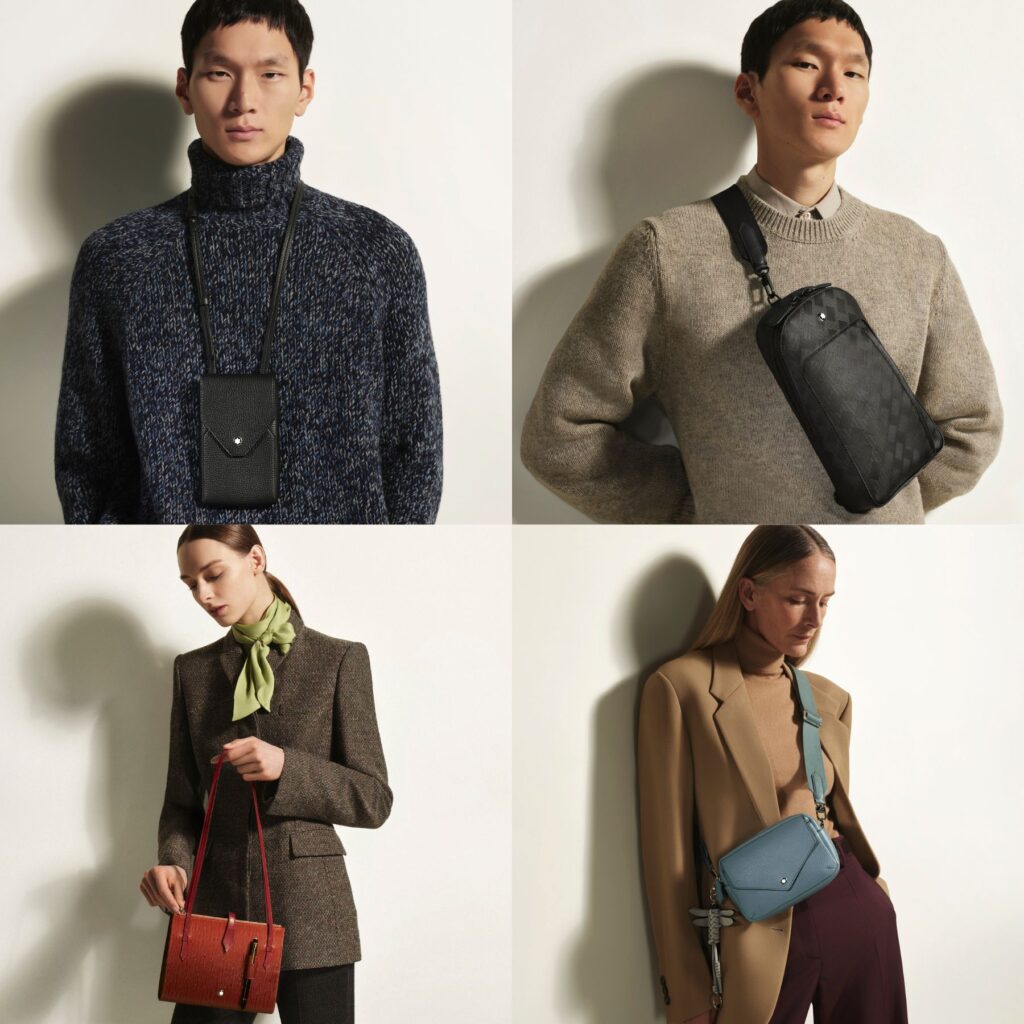
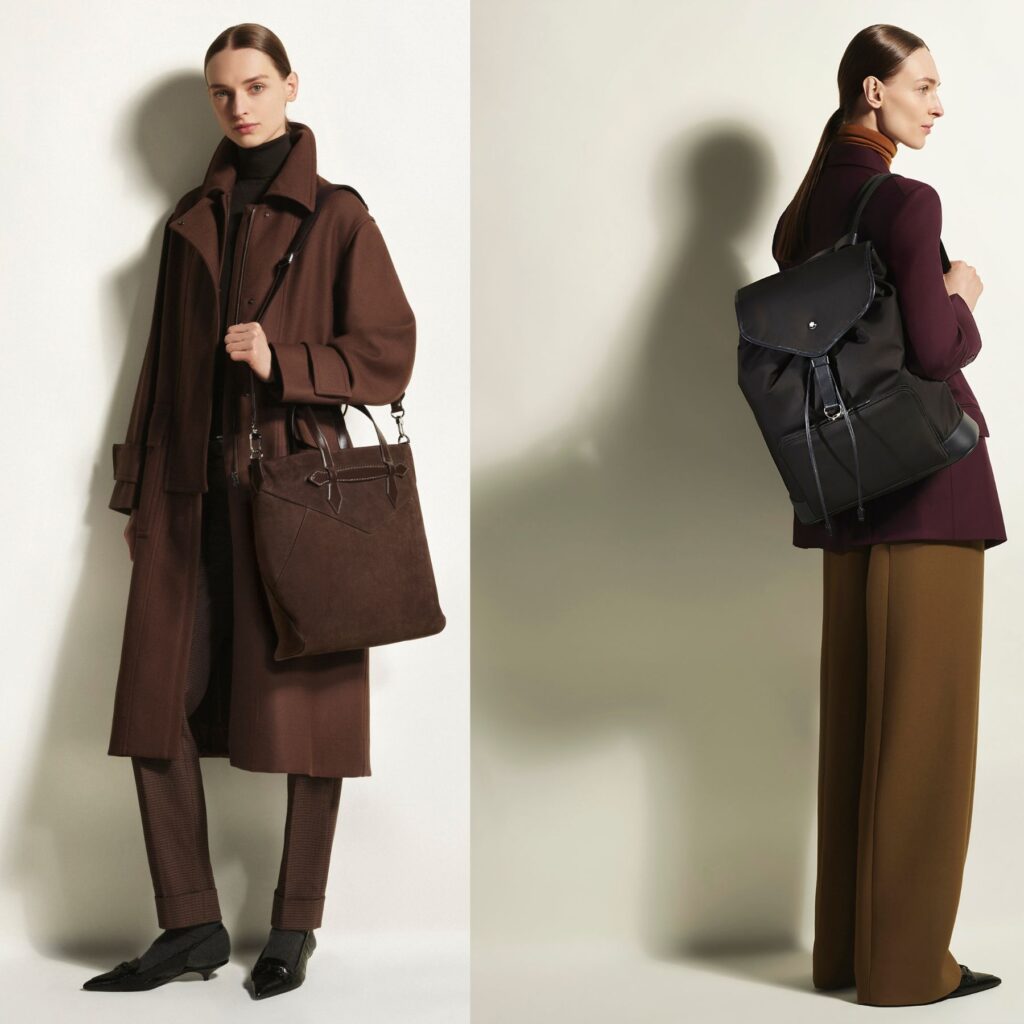
Created under the artistic direction of Marco Tomasetta, Montblanc’s Fall/Winter 2026 leather collection explores softer constructions, tactile materials and a warm palette drawn from nature: ebony, bauxite, red oak and honey.
The most interesting development is the expansion of the Writing Traveller line.
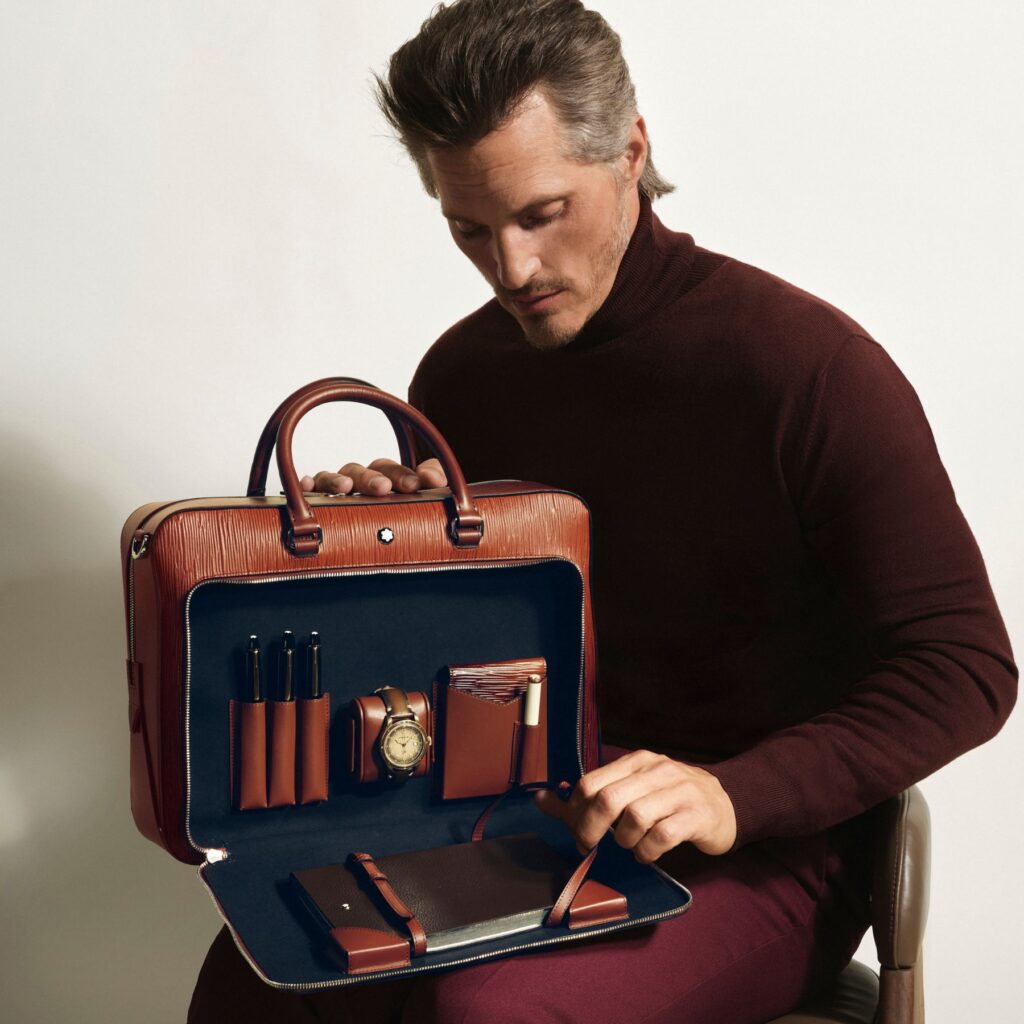
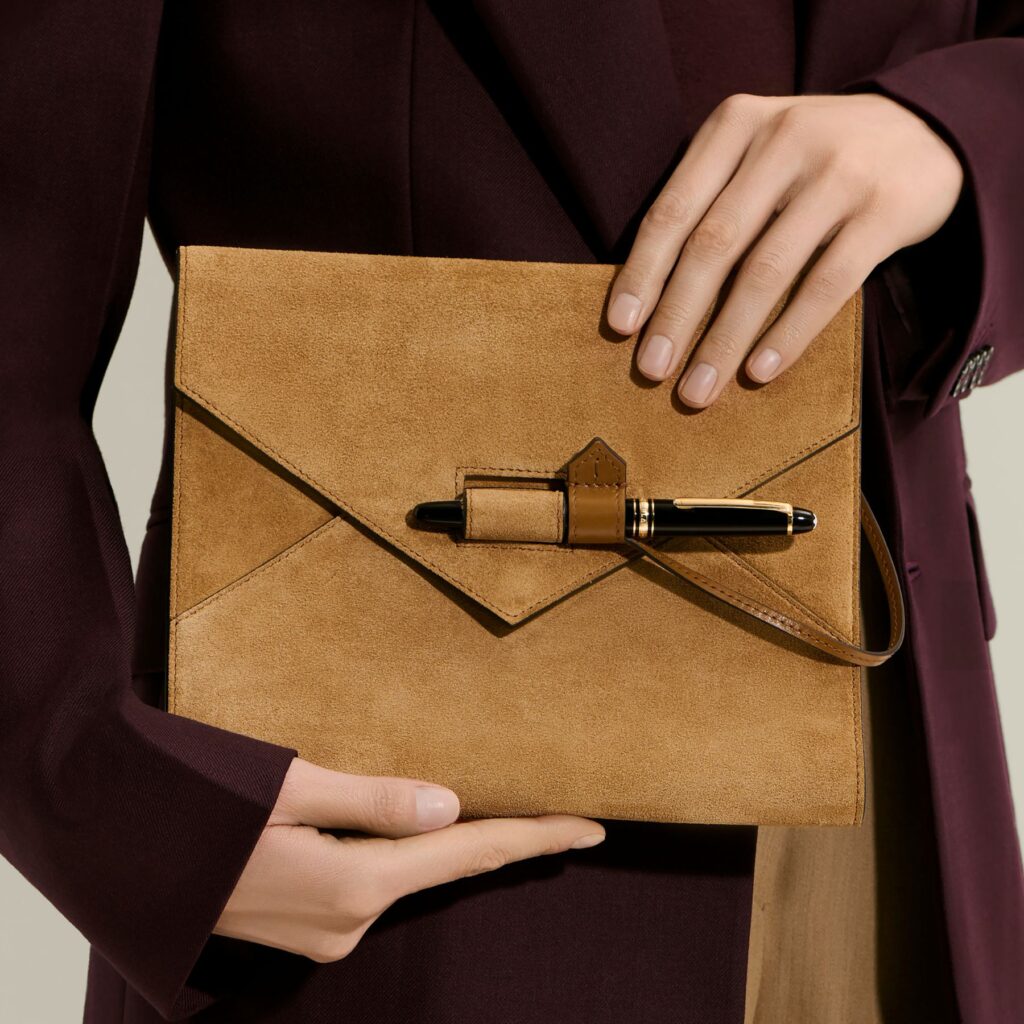
At its centre is the Writing Traveller Briefcase, now interpreted in grain leather after appearing in corteccia sfumato leather for Fall/Winter 2025. It is joined by more mobile formats including a Crossbody, Mini Crossbody and Clutch Document Holder. Inside, compartments have been conceived for writing instruments, notebooks, small accessories, watches, laptops and cables.
In other words, it is rather like carrying a small desk around with you — minus the chair and the drawer containing twelve pens that no longer work.
There are also new relaxed silhouettes in smooth calfskin, including the Panorama Backpack, Belt Bag and Weekender, while other travel pieces introduce lightweight, water-repellent technical fabric.
The important distinction is that Montblanc is not trying to make travel accessories look overtly futuristic.
Quite the opposite.
The technology is there to make the objects easier to live with. The emotional language remains resolutely analogue: leather, notebooks, pens, trains, desks, luggage and the promise of somewhere else.
Each piece is imagined as a travelling companion.
And, more interestingly, as the supporting cast in a journey whose protagonist is still you.
Why Does Montblanc FW26 Matter?
Because the collection belongs to something larger than handbags.
Luxury is becoming interested in reading again.
That may sound slightly absurd. Books never disappeared. But culturally, reading has moved from an ordinary habit to something approaching an act of resistance.
We live surrounded by abbreviated experience: reels instead of films, captions instead of essays, highlights instead of conversations, summaries instead of books.
Everything arrives pre-digested.
And perhaps that explains why literature, handwriting and analogue objects have acquired a new emotional value.
They demand something increasingly rare: attention.
Montblanc understands this rather well. Its current creative universe repeatedly returns to the desk, the written page and the journey as symbols of self-expression. At its FW26 presentation during Milan Fashion Week, even the setting continued the metaphor: train-car installations evoked the voyage in Wes Anderson’s Let’s Write, while Tomasetta’s Montblanc Desk appeared as the place from which ideas and journeys begin.
It would be easy to dismiss all this as clever luxury storytelling.
Of course it is clever luxury storytelling.
But good marketing usually works because it notices a desire that already exists.
And there is a growing appetite for things that return us to the physical world.
Reading Is Becoming a Luxury — But Not in the Way You Think
The luxury here is not the price of a fountain pen.
It is having enough interior space to use one.
Reading requires withdrawal from the spectacle. You cannot really read Anna Karenina while simultaneously checking WhatsApp, Instagram and whether somebody you went to school with has renovated her kitchen.
A book asks you to disappear for a while.
Travelling can do the same.
Not travelling as logistics — boarding passes, security queues and arguing with an airline app — but travelling as observation. Sitting somewhere unfamiliar. Watching how people speak. Noticing the architecture. Eating something whose name you cannot pronounce. Getting slightly lost.
Real life provides texture.
And texture gives us something worth writing about.
Which brings us to the most interesting part of Montblanc’s idea.
Writing is not simply the act of producing sentences.
It is the act of leaving a trace.
Can AI Replace a Writer’s Personal Voice?
AI can imitate structure. It can reproduce tone. It can even become unnervingly good at recognising our favourite turns of phrase.
What it cannot do is have been there.
It did not miss the train.
It did not sit beside the impossible aunt at Christmas lunch.
It did not walk alone through Rome after an argument, fall in love in Lisbon, change its mind about somebody on a train to Paris or suddenly understand its mother twenty years too late.
Those experiences belong to a human life.
And perhaps this is the real counterpoint to artificial intelligence: not refusing technology, but refusing to outsource experience.
Because an original voice is built from what we have seen, loved, endured, reconsidered and remembered.
You have to live before you have something to say.
Then you write it down.
That is your signature.
Four Books That Prove the Best Souvenir Is a Story
Montblanc’s Writing Traveler naturally sent us back to one of literature’s oldest combinations: writers leaving home.
Not because travel automatically makes anyone interesting. Airports have provided sufficient evidence to the contrary.
But because displacement sharpens observation.
In Patagonia — Bruce Chatwin
Chatwin travelled through Patagonia gathering landscapes, encounters, legends and eccentric characters, producing a book whose fragmented structure feels almost like opening somebody else’s very sophisticated travel notebook.
The destination matters, but the people met along the way matter more.
Which is usually how the best journeys work.
A Time of Gifts — Patrick Leigh Fermor
At eighteen, Patrick Leigh Fermor set out to walk from London towards Constantinople, crossing a Europe that was about to disappear into the Second World War. A Time of Gifts recounts the first part of that extraordinary journey.
It is travel writing as cultural memory: houses, conversations, landscapes and encounters preserved because somebody paid attention.
A useful reminder that sometimes the most important thing in your luggage is curiosity.
The Great Railway Bazaar — Paul Theroux
In 1973, Paul Theroux travelled by train from Britain through Europe, the Middle East and Asia before returning via the Trans-Siberian Railway. The result is The Great Railway Bazaar, built as much from conversations and observations as destinations.
It is perhaps the perfect companion to Montblanc’s current railway mythology.
Although Theroux’s trains contain considerably fewer impeccably dressed Wes Anderson characters.
Travels with Charley — John Steinbeck
At 58, Steinbeck drove across America with his French poodle Charley, trying to reconnect with a country he felt he no longer properly knew. The resulting book became both a travel narrative and a portrait of its author observing America — and himself — from the road.
Which may be the real reason we travel.
We leave home expecting to discover somewhere else and return having discovered something about ourselves.
Window Shop Verdict
So yes, we came to the Montblanc FW26 collection for the bags.
We stayed for the philosophy.
The Writing Traveller Briefcase, the soft calfskin pieces, those autumnal shades of ebony, bauxite, red oak and honey — they are beautiful objects. But what makes the collection interesting is the world Montblanc is constructing around them.
A world in which people still carry notebooks, read books on trains and occasionally look out of the window instead of at a screen. Where travelling somewhere means actually being there — noticing the place, the people, the peculiar little details that no photograph quite captures. And where putting pen to paper remains a way of keeping something from disappearing into the general blur of the feed.
In The Matrix, Neo eventually has to choose between two pills.
Montblanc’s version appears to be rather more civilised.
Pack a bag.
Take a book.
And write your own story.
Images courtesy from ©Montblanc
SHARE



