What Jewellery Should You Pack for a Beach Holiday?

From gold hoops at breakfast to pearls after sunset, here is how to choose holiday jewellery that survives heat, sweat, sunscreen and the occasional encounter with the Mediterranean.
Jewellery on holiday performs a small but useful miracle. A plain linen dress becomes an outfit. A white shirt looks intentional rather than recently rescued from a suitcase. Even hair that has surrendered completely to sea air can be forgiven by a good pair of earrings.
The problem is that beaches are not especially hospitable places for jewellery. There is heat, perspiration, sunscreen, salt water, chlorine and sand — which is essentially an exfoliant with no respect for sentimentality.
So, what jewellery should you pack for a beach holiday? The best holiday jewellery is light, versatile and made from durable materials, but even solid gold and diamonds should normally be removed before swimming. The aim is not to pack pieces that are indestructible. Such pieces rarely exist. It is about choosing jewellery that suits the climate, your clothes, and the rhythm of the holiday without requiring the vigilance of a museum curator.
First, a small but important distinction
Beach jewellery is not necessarily jewellery you should wear in the sea.
A pair of solid-gold hoops may be perfect with a swimsuit and kaftan at lunch. That does not mean they should accompany you on a forty-minute swim. Cartier advises removing jewellery before going to the beach or swimming because seawater and chlorine may tarnish metals, while cosmetics and moisturising lotions can damage metals, stones and pearls. Tiffany similarly recommends removing gold and platinum jewellery before swimming in the sea or a pool and before applying lotions or other cosmetics.
There is also the unromantic possibility of losing it. Cold water can make fingers temporarily contract, waves are not known for returning diamond rings, and a delicate clasp is no match for an enthusiastic towel.
The most useful rule is therefore simple:
Wear jewellery beside the water, not necessarily inside it.
The best jewellery to pack for a beach holiday
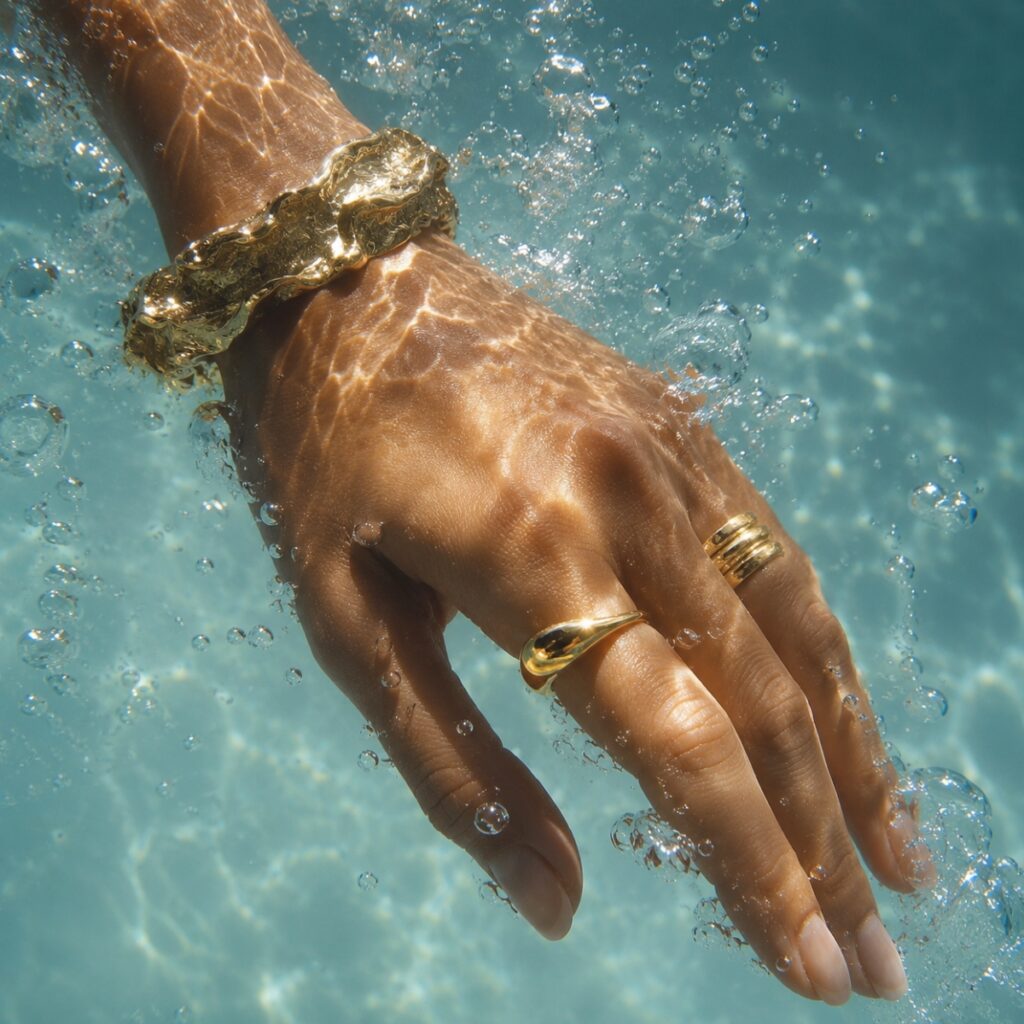
1. A pair of solid-gold hoops
Few pieces work harder on holiday than medium-sized gold hoops. They suit a swimsuit, a cotton poplin shirt, an evening dress and the slightly optimistic outfit chosen for a local market before discovering it is 36 degrees in the shade.
Choose solid 14k or 18k gold, rather than gold-plated metal. Solid gold is more durable than plating, which may wear or discolour more quickly when exposed to sweat, cosmetics and moisture.
Keep the design light enough to wear all day and secure enough that you are not repeatedly touching the fastening. Huggies and medium hoops with reliable hinged closures are generally more practical than very large, thin hoops.
2. A simple gold chain
A fine or medium-weight gold chain gives shape to open shirts, simple dresses and swimwear without making the wearer appear overly decorated at ten in the morning.
A shorter chain sitting close to the collarbone is often the easiest option in hot weather. Very long chains can tangle with bikini straps, bag handles and loose linen. They also collect more sunscreen because they sit directly against the upper chest.
Choose a chain with:
- solid construction rather than fragile plating;
- a reliable lobster or spring-ring clasp;
- links substantial enough not to knot immediately;
- no delicate pendant that could be damaged by cosmetics.
Apply sunscreen first, allow it to absorb, then put on the necklace. Sunscreen can leave an oily film on metals and gemstones, dulling their surface and attracting dust and sand.
3. One pair of evening earrings
Holiday packing tends to produce a particular delusion: that each dinner requires an entirely new jewellery identity. It does not.
Pack one pair of earrings with enough presence for the evening. These might be sculptural gold earrings, diamond studs, coloured-stone drops or a restrained pair of chandelier earrings.
They should work with every dinner dress you have brought. A useful test is whether they suit black, white and one strong colour. If they do, they have earned their place in the jewellery case.
4. A durable pendant with meaning
A medal, cross, initial, talisman or small diamond pendant can become the emotional centre of a holiday jewellery wardrobe.
These pieces feel personal rather than styled. They also work well in photographs because they belong to the wearer, not merely to the outfit. Style is often most convincing when it resembles memory rather than costume.
However, even a meaningful pendant should be removed before swimming if it is valuable, delicately set or attached to a fine chain. Devotion does not require testing the clasp against the Adriatic.
5. A cuff or substantial bracelet for dinner
Bracelets can feel uncomfortable when the day is very hot, particularly if wrists swell slightly. For daytime, it may be better to leave them aside.
In the evening, however, one substantial cuff or smooth gold bracelet can replace several smaller pieces. It works especially well with sleeveless dresses, caftans and simple tailoring.
Avoid tightly stacked bracelets on very hot days. Sweat, sunscreen and friction between pieces may dull their surfaces and cause scratching. Jewellery can scratch when pieces rub against one another, which is why Cartier recommends storing them separately as well.
6. One inexpensive, emotionally expendable piece
Not every holiday piece needs to be precious. A good resin bangle, colourful beaded necklace or woven bracelet can add wit to an otherwise neutral wardrobe.
The important phrase is emotionally expendable.
Do not pack costume jewellery that would cause genuine grief if it tarnished, broke or disappeared. Heat, moisture, sweat and sunscreen are particularly unkind to inexpensive alloys, glued stones and plated finishes.
The holiday should not include a small funeral for a necklace bought in Paris in 1998.
Which jewellery materials cope best with summer?
Solid gold
Solid gold is among the more practical precious metals for holiday wear, particularly in simple designs without fragile settings. Both 14k and 18k gold can be good choices.
Fourteen-carat gold contains a higher proportion of alloying metals than 18k gold and is generally somewhat harder, making it useful for pieces likely to receive frequent wear. Eighteen-carat gold has a richer gold content and colour but still requires care.
Neither should be treated as seawater-proof or chlorine-proof. Chlorine can damage gold alloys, while salt, sweat and cosmetics can leave residue and contribute to dullness or discolouration. The GIA warns that chlorine bleach can pit or damage gold alloys.
Verdict: Excellent for holiday wear, but remove before swimming, sports and sunscreen application.
Platinum
Platinum is dense, durable and resistant to ordinary tarnishing. It is a sensible material for jewellery worn frequently, particularly engagement rings.
But durability does not mean immunity. Platinum develops surface scratches and a patina, while sunscreen can cloud the appearance of both the metal and any stones. Tiffany advises removing platinum jewellery before swimming and before using cosmetics or lotions.
Verdict: Durable, but too valuable to treat casually at the beach.
Stainless steel
Good-quality stainless steel is one of the more forgiving materials for casual summer jewellery. It resists ordinary corrosion better than many base-metal alloys and is frequently used for watches and fashion jewellery intended for regular wear.
Still, quality varies considerably. Clasps, coatings and decorative elements may be less resistant than the steel itself.
Verdict: A practical choice for inexpensive holiday jewellery, especially when uncoated and well made.
Titanium
Titanium is light, strong and corrosion-resistant, making it comfortable in hot weather and useful for travellers sensitive to heavy earrings.
Its cool grey colour also works well with minimal summer clothes, although it offers a more contemporary, utilitarian appearance than traditional gold.
Verdict: One of the most practical materials for low-maintenance summer pieces.
Diamonds, sapphires and rubies
Diamonds, sapphires and rubies are relatively hard stones, but the setting holding them is often more vulnerable than the stone itself.
Diamonds may also look surprisingly lifeless after repeated contact with sunscreen and body oils because residue adheres to their surface and collects beneath the setting. Cartier notes that diamonds can be worn regularly but should still be protected from knocks. Sapphires and rubies are hard yet remain vulnerable to impact.
Verdict: Suitable for careful holiday wear. Remove before swimming, beach sports and vigorous sunscreen application.
Also read: Expert Tips on How to Clean Your Jewellery
Which jewellery materials should you avoid at the beach?
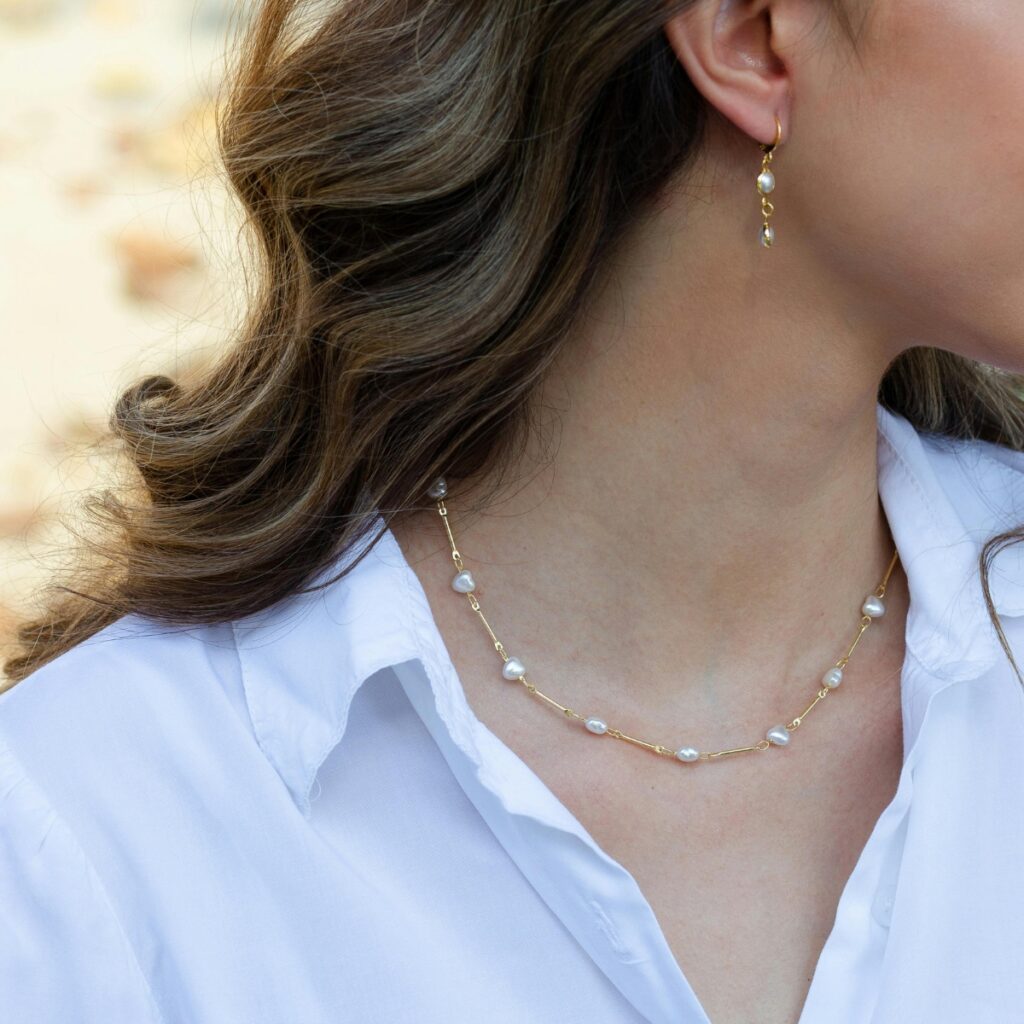
Gold-plated and vermeil jewellery
Gold-plated jewellery may be lovely, but it is not the obvious companion to sweat, salt water and frequent applications of SPF.
The layer of gold may gradually wear away, revealing the underlying metal. Friction from sand, towels and clothing can accelerate the process. Gold vermeil has a thicker gold layer than conventional plating, but it is still a surface treatment rather than solid gold.
Avoid wearing it in the sea, pool or shower. Put it on after sunscreen and wipe it gently after use.
Sterling silver
Sterling silver can look wonderful with summer whites, but beach conditions encourage tarnishing. Tiffany notes that silver tarnishes particularly when exposed to salt air, humidity, sweat, cosmetics and chlorine.
This does not mean silver must remain at home. A substantial silver cuff or earrings can be excellent for evening. Just keep them dry, wipe them after wear and store them in an anti-tarnish pouch.
Verdict: Pack it for dinner, not for swimming.
Brass, copper and unknown base metals
Brass and copper can oxidise in heat and moisture and may leave green or dark marks on the skin. Sweat, salt and sunscreen can accelerate the reaction.
Some people enjoy the changing patina of these materials. Most do not enjoy discovering it on their neck five minutes before dinner.
Verdict: Avoid unless the piece is intentionally designed to patinate and you accept the consequences.
Pearls
Pearls look as though they were invented for summer: luminous, feminine and faintly reminiscent of a Slim Aarons photograph. They are also organic gems that require more care than their composed appearance suggests.
Pearls are soft, easily scratched and sensitive to chemicals. Perfume, hairspray, creams and sunscreen can damage their surface. High heat may dry them out, leading to discolouration or cracking, while the silk thread used in many pearl necklaces can stretch or weaken when wet.
Wear pearls in the evening, after cosmetics have been applied. Wipe them with a soft cloth before returning them to their pouch.
Verdict: Beautiful for dinner. Entirely unsuitable for the pool.
Opals
Opals contain water within their structure and can be sensitive to extreme heat, dryness and abrupt temperature changes. Excessive heat may cause them to lose moisture, change colour or develop fine cracks.
They are also softer and more vulnerable to scratching than diamonds, sapphires or rubies.
Verdict: Leave valuable opals at home during very hot beach holidays.
Turquoise, coral and other porous or organic materials
Turquoise is porous and may absorb oils, creams and chemicals, altering its colour. Coral is organic, comparatively soft and sensitive to acids, cosmetics and abrasion.
The GIA specifically advises protecting porous stones such as turquoise from lotions, perfume and other cosmetics that may permanently damage their surface.
Verdict: Wear only with care, away from sunscreen, sea and pool water.
Amber
Amber is organic, soft and heat-sensitive. Perfumes, hairspray, sunscreen and strong cleaners can mark or cloud its surface. Prolonged heat and direct sun are also unhelpful.
Verdict: Better suited to a cool evening than a hot afternoon on the sand.
Leather, silk cord and fabric jewellery
Leather can absorb water, perspiration and sunscreen. It may stiffen, stain, dry out or begin to smell less like artisanal craftsmanship and more like a changing room.
Silk, cotton and woven cords can stretch, fade and retain moisture. They may be perfectly appropriate for inexpensive beach pieces, but they should not be confused with durable materials.
Verdict: Fine for casual use, provided you keep them out of the water and accept visible ageing.
Glued stones and embellished costume jewellery
Heat can soften some adhesives, while water and sunscreen may weaken them. Sand then contributes abrasion with great enthusiasm.
Verdict: Leave intricate costume jewellery for city dinners rather than beach days.
Can you wear jewellery in salt water?
Technically, some simple solid-metal jewellery may survive brief exposure to salt water. That is not the same as recommending it.
Salt residue can remain around clasps, hinges and settings. It may dull surfaces and contribute to corrosion in less resistant components. The greater danger is often mechanical: chains can break, clasps can open, and rings can slip from cold fingers.
The safest answer is therefore:
Remove fine jewellery before entering the sea, regardless of its metal.
If a piece is accidentally exposed, rinse it in fresh water, dry it thoroughly with a soft cloth and check the clasp and setting.
Is pool water worse than seawater for jewellery?
Chlorinated pool water can be particularly damaging to metals and jewellery alloys. Chlorine may discolour, weaken or pit certain gold alloys and accelerate tarnishing in silver. Jewellery houses routinely recommend removing pieces before swimming in pools.
Hot tubs should be treated with even more suspicion because they combine chemicals with heat.
No necklace has ever improved its character in a jacuzzi.
How does sunscreen affect jewellery?
Sunscreen is essential for the skin but less useful to diamonds and polished metal.
It can form a greasy film over stones, making them look cloudy, and gather in the spaces beneath settings. It also attracts sand, lint and dust. Repeated exposure may contribute to tarnishing or discolouration, particularly on silver, plated metals and lower-quality alloys.
The correct order is:
- Apply sunscreen.
- Allow it to absorb and dry.
- Wash or wipe your hands.
- Put on your jewellery.
Remove rings and bracelets before reapplying SPF during the day.
What about sweat?
Sweat contains water, salts and other compounds that can leave residue on metals and stones. Its effect depends on the jewellery material and on the wearer’s individual skin chemistry.
Solid gold, platinum and good-quality stainless steel generally cope better than silver, brass, copper and plating. Nevertheless, jewellery worn during a very hot day should be wiped with a clean, soft cloth before storage.
Heavy necklaces, tight chokers and stacked bracelets can also become physically uncomfortable in humidity. Summer elegance improves considerably when circulation is allowed to continue.
How to pack jewellery without tangles or scratches
A proper travel jewellery case is more useful than another pair of sandals you will not wear.
Choose one with separate padded sections, ring rolls and small compartments. Store each piece individually because metals and stones can scratch one another. Fasten chains before laying them flat, and thread very fine chains through a drinking straw or jewellery card if they are prone to tangling.
For valuable pieces:
- carry them in hand luggage;
- photograph them before travelling;
- record receipts, certificates and serial numbers;
- check whether your insurance covers travel and loss outside the home;
- avoid leaving jewellery loose in hotel bathrooms or beach bags.
Do not transport necklaces in a single silk pouch unless you wish to spend the first evening solving a metallic riddle.
The Notorious beach jewellery capsule
For a one-week holiday, this is enough:
- one pair of solid-gold hoops or huggies;
- one simple gold chain;
- one meaningful pendant;
- one pair of diamond or gemstone studs;
- one stronger pair of evening earrings;
- one cuff or sculptural bracelet;
- one playful, inexpensive summer piece.
That selection can dress a swimsuit, white shirt, linen trousers, kaftan, cotton dress and evening slip without becoming a second wardrobe.
The clever holiday jewellery collection is not the largest. It is the one in which every piece has a reason to be there.
The final rule: never pack what you cannot bear to lose
Beach holidays create a false sense of security. Everything feels softer: the schedule, the clothes, one’s judgement regarding a second glass of wine. But valuable jewellery remains valuable, and sentimental jewellery is often impossible to replace.
Leave irreplaceable heirlooms, elaborate antique settings and exceptionally valuable pieces at home unless the occasion genuinely requires them.
Pack jewellery that helps you feel like yourself, only with better light and fewer emails.
That, after all, is what a holiday is for.
Beach jewellery FAQ
| What is the best metal for beach jewellery? | Solid gold, titanium and good-quality stainless steel are among the more practical choices for hot-weather wear. However, fine jewellery should still be removed before swimming in seawater or chlorinated pools. |
| Can I wear 18k gold in the sea? | Brief contact may not immediately ruin 18k gold, but seawater can leave residue around settings and clasps, and jewellery may be lost while swimming. Removing it before entering the sea is the safer choice. |
| Can I wear diamonds at the beach? | Diamonds are hard, but sunscreen, body oils and sand can dull their appearance, while the metal setting may be scratched or damaged. Wear diamond jewellery beside the beach rather than in the water. |
| Should I take my engagement ring on holiday? | Take it only when you are comfortable with the risk and your insurance provides appropriate travel cover. Remove it before swimming, applying sunscreen, exercising or handling luggage. |
| Can pearls be worn in hot weather? | Pearls can be worn in summer, preferably in the evening and after perfume, hairspray and skincare have dried. Avoid prolonged heat, sunscreen, sea water and pool water. |
| How should I clean jewellery after a beach holiday? | For simple solid-gold or platinum jewellery without delicate stones, use lukewarm water, mild soap and a very soft brush, then rinse and dry thoroughly. Pearls, opals, turquoise, coral, antique pieces and complex settings require specialist care. |
images created by @notoriousmag
SHARE



