100 Years of the Rolex Oyster: The Watch That Changed Time

From Mercedes Gleitze’s Channel swim to the understated Oyster Perpetual created for the centenary, Rolex celebrates a watch that taught luxury how to survive real life.
A hundredth anniversary presents a peculiar problem for a watchmaker. How do you celebrate the passage of time without producing something that looks imprisoned by the past?
For the centenary of the Rolex Oyster, the answer is a watch remarkably free of commemorative theatre. No oversized dates, elaborate engravings or historical scene reproduced across the dial. Instead, Rolex has created an Oyster Perpetual 41 whose anniversary details reveal themselves slowly: a slate dial, touches of the house’s green, yellow gold placed against steel and the number 100 discreetly incorporated into the design.
The restraint is appropriate. The history of the Oyster was never based on decoration. It began with the rather practical question of how to protect a wristwatch from water.
Why was the Rolex Oyster so important?
In 1926, Rolex introduced the Oyster, widely recognised as the first waterproof wristwatch with a hermetically sealed case. Its name was deliberately literal. Like an oyster shell protecting what lies inside, the case enclosed the movement against water, dust and the small intrusions of everyday life.
This may sound rather ordinary to us now. We wear watches in swimming pools, showers and sudden summer storms without giving the matter much thought. In the 1920s, however, the wristwatch was still a vulnerable object. Moisture could damage the mechanism, while the winding crown presented a particularly difficult point of entry.
Hans Wilsdorf, the founder of Rolex, understood that a watch intended for modern life could not remain a delicate ornament. It had to accompany the wearer outside the drawing room.
The Oyster helped change the wristwatch from something one protected into something one could trust.

Read also: Is Vintage Rolex a Good Investment? Ask Paul Newman’s Daytona Watch
Mercedes Gleitze and the swim that made watchmaking history
A technical invention still requires proof. Rolex found it in Mercedes Gleitze, a British swimmer whose courage would become inseparable from the Oyster story.
On 7 October 1927, Gleitze became the first British woman to swim across the English Channel. Her achievement was soon questioned after another swimmer made a fraudulent claim, and so Gleitze returned to the water on 21 October for what became known as the Vindication Swim.
For this second attempt, an Oyster was suspended around her neck. Gleitze remained in the freezing water for more than ten hours before abandoning the crossing because of the conditions. The woman was exhausted; the watch continued to function.
That distinction matters. The familiar simplified version says that Gleitze crossed the Channel wearing the Rolex. In fact, the Oyster accompanied her during the second, unfinished swim. Yet the result was no less persuasive. After hours of exposure to cold seawater, the mechanism remained protected. Rolex had taken its claim out of the laboratory and placed it in the Channel.
Wilsdorf then placed a full-page advertisement in the Daily Mail, presenting the Oyster’s performance to the public. It was an early example of a brand using a real person and a genuine physical test to give meaning to an innovation.
Long before the expression brand ambassador entered every marketing meeting on earth, Mercedes Gleitze had shown what such a partnership could be. She was not merely photographed beside the product. She gave the product a story of endurance.
From Oyster to Oyster Perpetual
The next decisive development arrived in 1931, when Rolex patented a self-winding mechanism with a freely rotating rotor. The movement could be wound by the natural motion of the wrist, giving rise to the name “Perpetual”.
The Oyster protected the movement. The Perpetual rotor kept it running.
Together, these two ideas became the technical and philosophical foundation of the modern Rolex. The Explorer, Submariner, GMT-Master and Datejust may have developed their own identities, but they all inherited something from that original sealed case.
The Oyster Perpetual remains the purest expression of the concept: hours, minutes and seconds, enclosed in a robust waterproof case, without complications competing for attention.
Perhaps this is why the model has become more culturally interesting with age. It does not perform status quite as loudly as some of its relatives. It simply contains the essential Rolex grammar.
How Rolex is celebrating 100 years of the Oyster
For the centenary, Rolex has created an Oyster Perpetual 41 in yellow Rolesor, the house’s combination of yellow gold and Oystersteel. The choice feels particularly appropriate: gold brings the warmth and formality of traditional watchmaking, while steel recalls the practical purpose of the original Oyster.
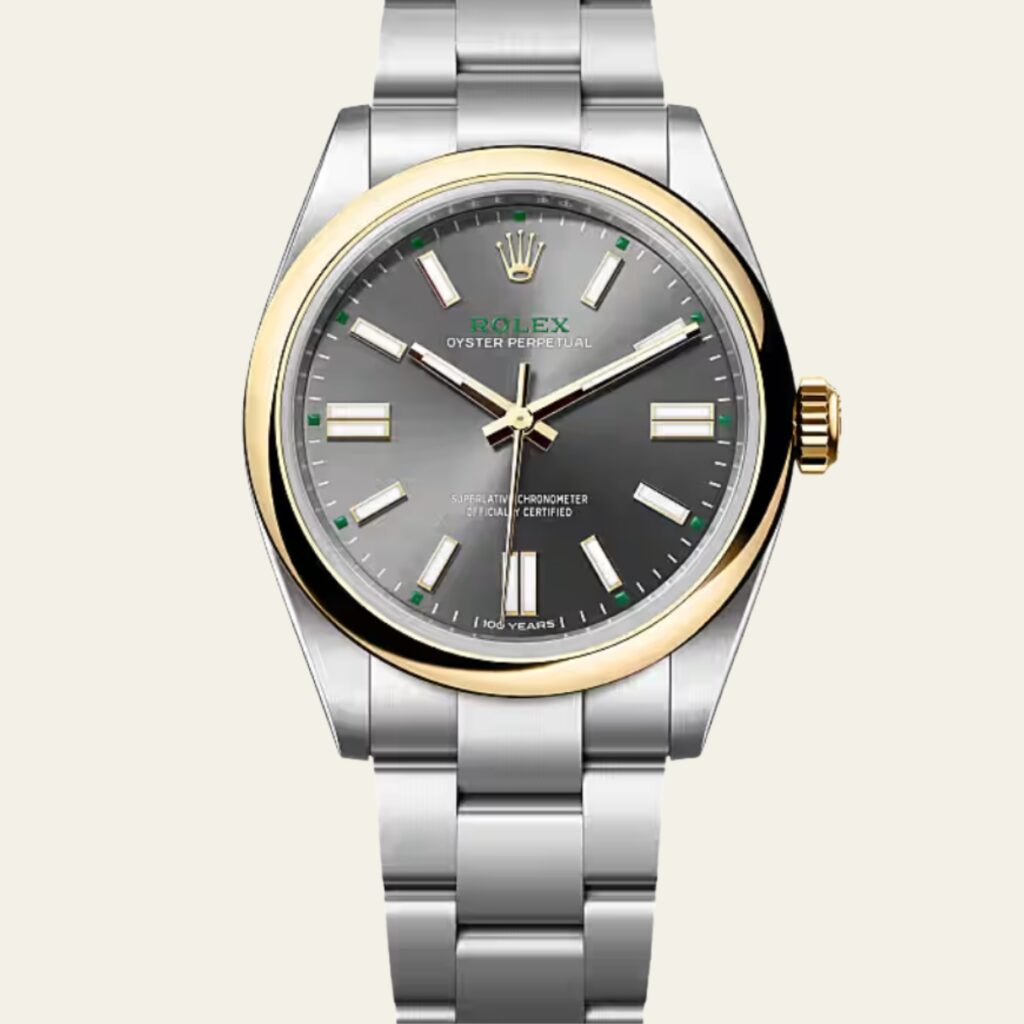
The anniversary edition’s defining features include:
- A 41 mm yellow Rolesor case: The polished bezel and winding crown are made from yellow gold, while the case and Oyster bracelet are crafted in Oystersteel.
- A slate-coloured dial: Restrained and slightly industrial, the dial connects the celebratory model to the utilitarian origins of the Oyster.
- Rolex’s historical green: The Rolex name and the small square minute markers are printed in green using tampography, an indirect printing technique capable of applying particularly precise details to a dial.
- Two discreet references to the centenary: The words “100 years” replace the traditional “Swiss Made” inscription at six o’clock, while the number 100 also appears on the winding crown.
- Water resistance to 100 metres: A fitting specification for a watch whose history began with the ambition to create a hermetically sealed wristwatch.
- Rolex calibre 3230: The self-winding mechanical movement is equipped with the Chronergy escapement, a blue Parachrom hairspring and Paraflex shock absorbers.
- Approximately 70 hours of power reserve: The watch can remain unworn for most of a weekend and continue running.
- Superlative Chronometer certification: Rolex states a precision of minus two to plus two seconds per day after the movement has been placed inside the completed watch.
The technical specifications may seem far removed from the romance of Mercedes Gleitze swimming through the cold Channel. In truth, they continue the same proposition: a precise mechanical object should remain dependable in the real world.
Rolex has also extended the anniversary beyond the 41 mm model. The Oyster Perpetual 36 revisits the Jubilee dial introduced at the end of the 1970s, using the Rolex name to form a repeated pattern across the surface. For the centenary, the motif appears in ten lacquer colours, individually applied to create a multicoloured composition.
Where the slate-dial model approaches the anniversary through restraint and engineering, the Jubilee version allows the institution to loosen its collar.
Two further Oyster Perpetual models appear in 18-carat gold:
- Oyster Perpetual 28: Yellow gold with a green lacquer dial and heliotrope hour markers.
- Oyster Perpetual 34: Everose gold with a blue lacquer dial and dumortierite indices.
On both models, natural stones appear at three, six and nine o’clock — a first for Rolex.
Together, the anniversary watches offer several interpretations of the same heritage: technical continuity, playful colour and the particular assurance of gold. Rolex is not reproducing 1926. It is showing how a century-old idea can evolve without losing its identity.
A century of making permanence desirable
The Oyster’s centenary arrives at an interesting cultural moment. We are surrounded by objects designed for speed, replacement and immediate visibility. Technology becomes obsolete almost as soon as we learn where its settings are hidden. Fashion is frequently asked to manufacture novelty before the previous idea has had time to become familiar.
A mechanical watch proposes a different relationship with time. It requires care, servicing and continuity. Its value lies partly in the expectation that it will remain.
The original Oyster was revolutionary because it protected a delicate mechanism from the world. A hundred years later, that idea feels unexpectedly emotional. We still want objects capable of accompanying us rather than demanding to be replaced by us.
Mercedes Gleitze entered cold water with a watch around her neck and something to prove. The Oyster emerged as evidence that endurance could be engineered. Rolex has spent the following century refining that promise.
The anniversary model does not attempt to recreate 1926. It carries the story forward in steel, gold and slate grey, with the number 100 placed where only an attentive eye will find it.
After all, permanence rarely needs to raise its voice.
Images Courtesy @Rolex
SHARE



